

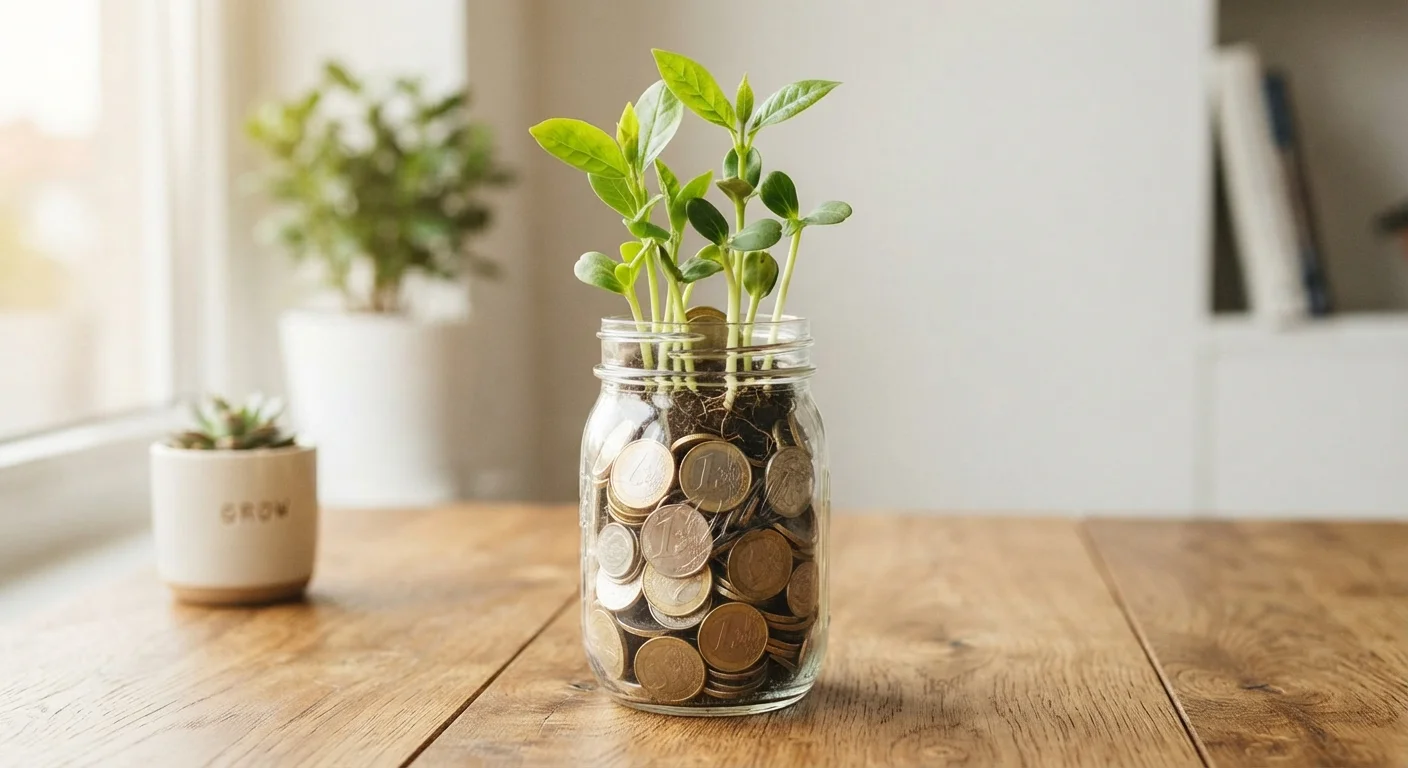
What Compound Interest Actually Means
Most people have heard that compound interest is powerful. Fewer understand exactly why. The concept is simpler than it sounds: when your money earns interest, that interest gets added to your balance. Going forward, the entire balance - original deposit plus accumulated interest - earns the next round of interest.
Here's a straightforward illustration. Suppose you deposit $1,000 at a 5% annual interest rate:
- Year 1: You earn $50 in interest. Your balance is $1,050.
- Year 2: You earn 5% on $1,050 - that's $52.50. Your balance is $1,102.50.
- Year 5: Your balance has grown to roughly $1,276 - without adding a single new dollar.
Each year, the dollar amount of interest earned increases because the base keeps growing. That's the compounding effect. For a deeper look at the vocabulary that surrounds this concept - including APY and yield - see key savings terms explained in plain language.
72
The Rule of 72 - years to double your money
Dividing 72 by your annual interest rate gives a rough estimate of how many years it takes for money to double; at 6%, that's approximately 12 years.
10-20×
Long-run growth of compounded vs. simple interest
Over multi-decade horizons, compound interest can produce balances 10 to 20 times larger than simple interest on the same principal, depending on rate and time.
$0
Minimum deposit needed to benefit from compounding
Compounding works on any balance - there is no minimum threshold required to begin benefiting, making it accessible to savers at every income level.
Why Time Is the Critical Variable
The single most important factor in compounding is time - not the amount you start with, and not even the interest rate. The longer money compounds, the more dramatic the results become. This is because compounding is exponential, not linear.
Consider two savers, both earning a hypothetical 6% annual return:
- Saver A invests $5,000 at age 25 and contributes nothing more. By age 65, that single investment grows to roughly $51,000.
- Saver B waits until age 35 to invest the same $5,000. By age 65, it grows to approximately $29,000.
Ten years of delay cost Saver B nearly $22,000 - from just one deposit. This isn't magic; it's math. Each decade of compounding multiplies what came before it.
“Compound interest is the eighth wonder of the world. He who understands it, earns it; he who doesn't, pays it.”
— Widely attributed to Albert Einstein, This quote, commonly cited in personal finance education, reflects a principle that financial educators broadly endorse: understanding compounding is foundational to building wealth and avoiding debt traps.
This is why financial educators consistently emphasize starting early over starting big. For guidance on building consistent habits that support long-term growth, see principles that guide effective long-term saving.
When Compounding Works Against You
Compound interest isn't always on your side. The same mechanic that grows savings accelerates debt when balances go unpaid. Credit cards are a common example: if you carry a balance month to month, interest is charged on interest already owed. That's why a $2,000 credit card balance at 20% APR can take years to pay off making only minimum payments - and cost hundreds more than the original balance.
Understanding this dynamic is essential to managing debt and credit. The straightforward takeaway: pay off high-interest debt as aggressively as possible, because compounding is working against your balance every month it remains unpaid.
A Simple Strategy: Prioritize High-Interest Debt First
If you're carrying multiple debts, focusing extra payments on the highest-interest balance first - sometimes called the avalanche method - minimizes the total interest compounding against you. Once the highest-rate debt is eliminated, redirect those payments toward the next-highest. This approach typically reduces total interest paid over time compared to spreading payments equally across all balances.
Putting Compounding to Work in Everyday Saving
Understanding compound interest is most useful when it changes your behavior. Three practical approaches make the biggest difference:
- Start as early as possible. Even small contributions made years earlier consistently outperform larger contributions made later.
- Contribute consistently. Regular additions - even modest ones - dramatically amplify compounding because each contribution has its own compounding runway ahead of it.
- Leave it alone. Withdrawing savings resets compounding's progress. Keeping money invested and untouched allows growth to compound continuously.
One of the most reliable ways to act on all three principles at once is automating your savings. When transfers happen automatically, consistency is built in - you remove the decision-making friction that causes gaps. See how automated savings actually work for a practical breakdown of how to set this up.
This article is for general informational and educational purposes only. It does not constitute personalized financial, investment, or tax advice. Please consult a qualified financial professional regarding decisions specific to your situation.