
The Five Factors Behind Your Score
Your credit score is not random - it is calculated from specific data points pulled from your credit report. The FICO model, used by the vast majority of US lenders, breaks that calculation into five weighted categories:
- Payment history (35%): Whether you pay bills on time is the most influential factor. Even one missed payment can cause a meaningful drop.
- Amounts owed / Credit utilization (30%): This measures how much of your available credit you're using. Keeping utilization below 30% is widely recommended; below 10% is even better.
- Length of credit history (15%): Longer histories generally help your score. This includes the age of your oldest account, your newest account, and the average age of all accounts.
- Credit mix (10%): Having a variety of account types - credit cards, installment loans, a mortgage - can positively affect your score.
- New credit (10%): Opening several new accounts in a short period can signal financial stress and temporarily lower your score.
Understanding these factors is the foundation for taking deliberate action. For a deeper look at the terms used in this calculation, see the Credit Glossary: Key Terms Every Borrower Should Know.
716
Average US FICO Score
According to FICO's most recently published data, the average American credit score sits in the 'good' range, meaning most consumers have reasonable credit access.
35%
Weight of payment history in FICO Score
FICO's published scoring criteria identify on-time payment history as the single largest factor in the standard scoring model.
26 million
Credit-invisible Americans
The Consumer Financial Protection Bureau (CFPB) has estimated that approximately 26 million Americans have no credit history with the major bureaus, making it impossible to generate a score.
What the Score Ranges Actually Mean
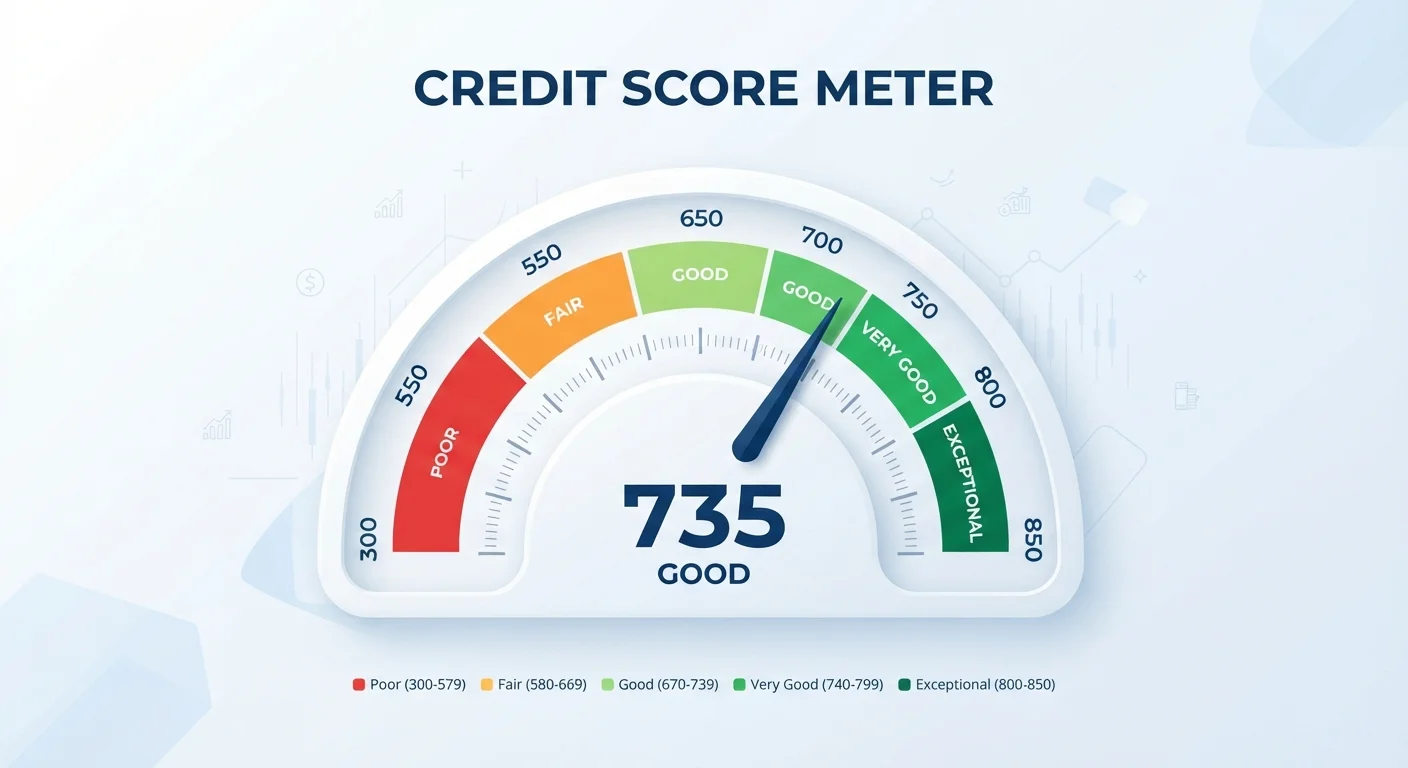
Credit scores fall into tiers that lenders use as rough benchmarks. Here is how the standard FICO ranges are generally interpreted:
| Score Range | Category | What It Typically Means |
|---|---|---|
| 800-850 | Exceptional | Qualifies for the best rates and terms available |
| 740-799 | Very Good | Likely to receive better-than-average offers |
| 670-739 | Good | Near or above the median US score; most loans accessible |
| 580-669 | Fair | May face higher rates or stricter requirements |
| 300-579 | Poor | Limited credit access; secured cards or credit-building tools often needed |
These ranges are guidelines, not hard cutoffs. Individual lenders set their own standards, and a score that earns approval at one institution might not at another. Your score is one part of the picture - lenders also consider income, employment, and your debt-to-income ratio when making lending decisions.
“Your credit score is essentially a summary of your financial reputation - a single number that encodes years of borrowing behavior into something lenders can act on in seconds.”
— Freddie Huynh, Former VP of Credit Risk Analytics, widely cited in consumer credit research
How Lenders Actually Use Your Score
When you apply for a mortgage, auto loan, or credit card, the lender pulls your credit score as part of a broader risk assessment. The score helps them answer one core question: how likely is this person to repay?
The practical consequences of your score show up in three main ways:
- Approval or denial: Many lenders have minimum score thresholds. Falling below them can mean an automatic decline.
- Interest rate offered: Borrowers with higher scores typically receive lower interest rates, which translates into real dollar savings over the life of a loan.
- Credit limit: On revolving credit like credit cards, a stronger score often means access to a higher limit.
Beyond lending, credit scores are also checked in some rental applications and, in certain states, by employers during background checks (with your permission).
Check Your Score Without Hurting It
You can view your credit score for free through many bank and credit card portals, or through federally authorized sources like AnnualCreditReport.com for your full report. These are soft inquiries and will never affect your score. Making it a monthly habit takes minutes and can catch problems early.
To understand the full data behind your score, it helps to read your actual credit report. Our guide on reading your credit report walks through every section in plain language.
Common Misconceptions Worth Clearing Up
Several widespread myths cause people to make counterproductive credit decisions. Two of the most damaging:
- "Carrying a balance improves my score." It does not. Paying your balance in full each month keeps utilization low and avoids interest charges. There is no benefit to carrying a balance.
- "Closing old accounts helps." Closing accounts typically reduces your available credit (raising utilization) and can shorten your average account age - both of which may lower your score.
For a full breakdown of credit myths, see Things People Get Wrong About Credit Scores.
This article is for general informational and educational purposes only and does not constitute personalized financial or credit advice. For guidance specific to your situation, consult a qualified financial professional.