

Why Pre-Trip Health Prep Matters More Than Most Travelers Realize
Most travelers check their passport expiration, book accommodations, and confirm flights - but health preparation often gets pushed to the last minute or skipped entirely. That's a meaningful risk. Vaccine-preventable diseases, altitude sickness, contaminated water, and gaps in medication supply are among the most common causes of disrupted or medically complicated international trips.
The good news: most of these risks are manageable with the right preparation. This checklist walks you through every major health consideration to address before you leave the country - from your first doctor's appointment to what goes in your carry-on bag. For a broader view of what a pre-departure medical visit actually involves, see why skipping that appointment can backfire.
This article provides general health information for educational purposes only. Always consult a qualified healthcare professional before making any decisions about vaccinations, medications, or medical care.
Don't Rely on Destination Pharmacies for Critical Medications
It's a common assumption that any medication you run out of can simply be purchased at a pharmacy abroad. In practice, many prescription drugs are unavailable, sold under different names, or require a local prescription in other countries. Generic formulations may also differ in concentration or composition. Always leave home with a complete supply of any medication you depend on, plus extra days' worth as a buffer.
Tools and Resources You'll Need
Before working through this checklist, gather or identify access to the following resources. Having them in hand makes every subsequent step faster and more accurate.
CDC Traveler's Health Website (wwwnc.cdc.gov/travel)
Look up destination-specific vaccine recommendations, disease risk levels, and outbreak alerts.
U.S. State Department Travel Advisories (travel.state.gov)
Check safety levels, entry requirements, and health advisories for your destination country.
Travel Medicine Clinic or Physician
Provide personalized vaccine recommendations, malaria prophylaxis prescriptions, and health risk assessment for your itinerary.
Current Prescription Records
Needed to obtain sufficient medication supply, documentation letters, and dosing guidance for travel.
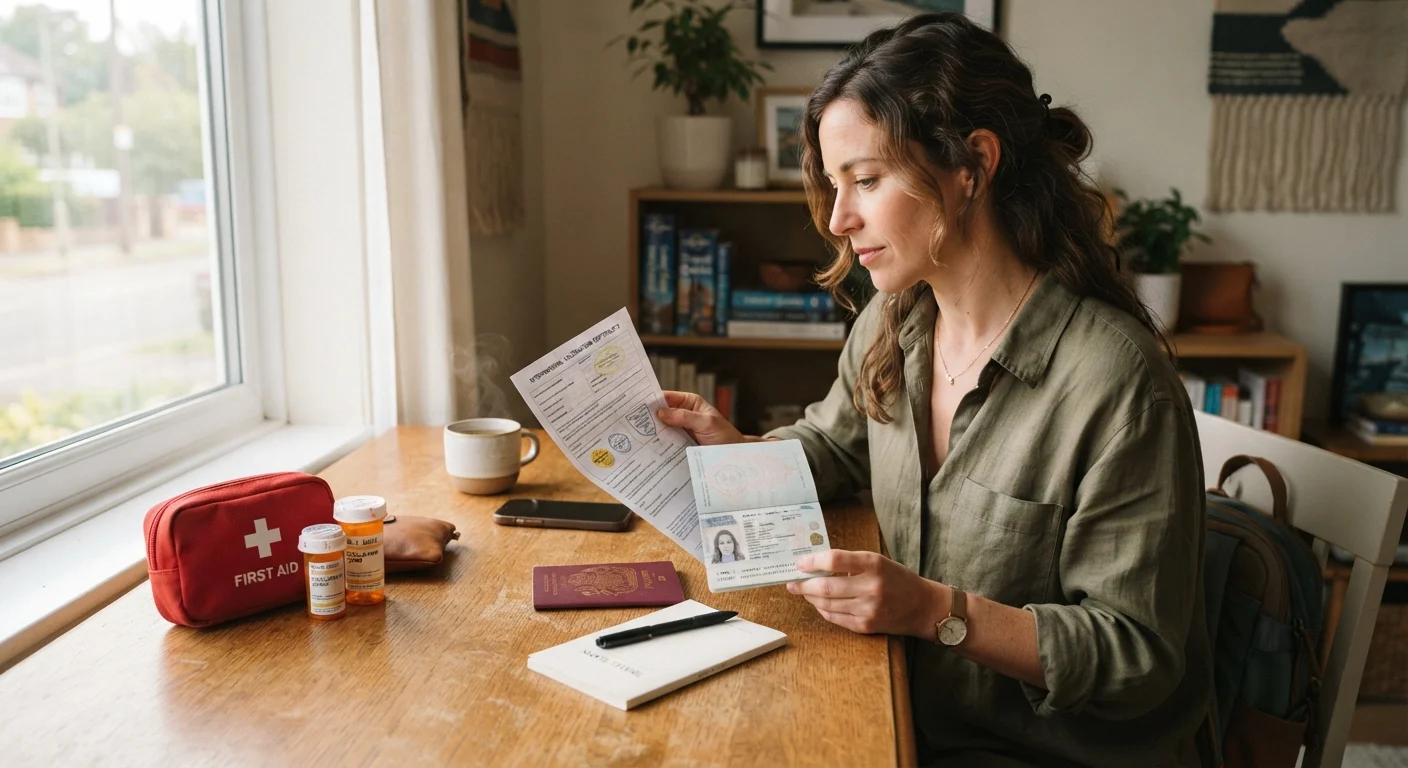
International Certificate of Vaccination (Yellow Card)
Official proof of required vaccinations, sometimes mandatory for entry into certain countries.
Travel Health Insurance Policy
Covers emergency medical costs and evacuation expenses that standard US health plans typically exclude abroad.
STEP Enrollment (Smart Traveler Enrollment Program)
Free U.S. government service that alerts embassies to your travel plans for emergency outreach.
The Complete Pre-Travel Health Checklist
Work through the groups below roughly in order - earlier items often inform later ones. For example, your destination's disease risks determine which vaccines to discuss, which in turn affects your timeline for scheduling a clinic visit.
Medical Consultation
Vaccinations
Prescription Medications
Travel Health Insurance and Emergency Planning
Travel Health Kit
Timing Is Non-Negotiable for Vaccines
Some vaccines require multiple doses spaced weeks apart, and many take two weeks or more to reach full effectiveness after the final dose. If you book a travel medicine appointment fewer than four weeks before departure, your options may be limited. Plan your health prep as early as you plan your flights - ideally at the time of booking. Late appointments are better than none, but earlier is always better.
Travelers managing chronic conditions should also review preparation strategies specific to their situation, which covers contingency planning in depth beyond what a general checklist can address.
Destination-Specific Risks Worth Researching
No two destinations carry identical health risks. A trip to Western Europe looks very different from a rural Southeast Asia itinerary or a high-altitude Andean trek. Use the CDC's Traveler's Health destination pages and the U.S. Department of State's country-specific advisories as your primary reference points - both are publicly available and regularly updated.
Key environmental and regional risks to investigate for your specific destination include:
- Altitude: Destinations above roughly 8,000 feet carry risk of acute mountain sickness. Acclimatization strategies and, in some cases, prescription medications are worth discussing with a physician.
- Water and food safety: This goes beyond the familiar advice to avoid tap water. Ice, raw produce, and street food all carry region-specific risk levels. See a fuller breakdown of water safety considerations for practical guidance.
- Sun and heat: UV intensity increases significantly at altitude and in tropical regions. Heat illness and UV exposure are among the most common - and underestimated - travel health hazards.
- Natural disaster risk: If your destination sits in a seismically active zone or hurricane belt, basic preparedness is worth adding to your planning. Flood, earthquake, and storm preparedness for travelers provides a useful framework.
For a structured approach to researching any destination's entry requirements, health advisories, and safety profile, the destination research guide is a reliable starting point.
This article is for general informational and educational purposes only. It does not constitute medical advice. Consult a licensed healthcare provider for guidance specific to your health history and travel destination.