

Why Medication Travel Rules Matter
Carrying prescription medications across borders is common, but it's not automatically straightforward. What's legally prescribed in the United States may be a controlled substance - or entirely prohibited - in another country. Failing to carry proper documentation can lead to confiscation at customs, delays, or in serious cases, legal consequences.
This reference covers the core rules, documentation standards, and practical logistics every traveler with prescriptions should understand before departure. For a broader health preparation checklist, see Travel Health Prep: What to Do Before You Leave the Country before your trip.
| Recommended supply to carry | Prescribed amount plus a few days' buffer (General guidance from travel medicine practitioners) |
| Where to store medications in transit | Carry-on baggage only (TSA and travel health standard guidance) |
| Key document required at borders | Original pharmacy-labeled container plus physician letter |
| Authority to verify country-specific rules | Destination country embassy or consulate (U.S. State Department recommendation) |
| Controlled substance travel guidance source | International Narcotics Control Board (INCB) (incb.org) |
Documentation You Should Carry
Having the right paperwork protects you at every checkpoint. At minimum, carry the following for each prescription medication:
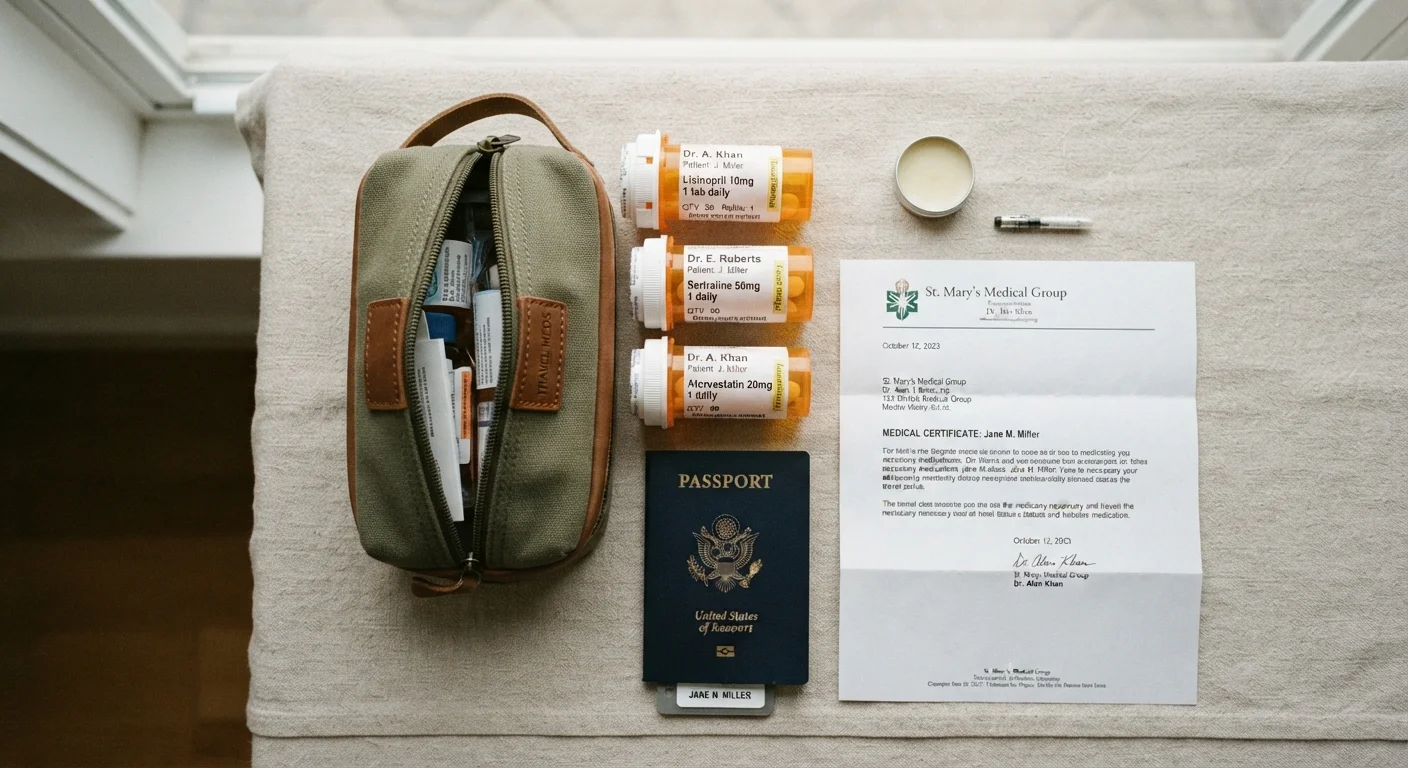
- Original pharmacy-labeled container showing your name, prescribing doctor, medication name, dosage, and dispensing date
- A letter from your prescribing physician on official letterhead, stating your diagnosis (or condition category), medication name, dosage, and that it is medically necessary
- A copy of the original prescription as a backup document
For controlled substances - such as opioids, benzodiazepines, or stimulants - some countries require notarized documentation or advance import permits. Contact the destination country's embassy or consulate well before travel to confirm what's required. The U.S. State Department and the destination country's health ministry are authoritative sources for this information.
Advance Planning Is Essential for Controlled Substances
Import permits for controlled medications can take several weeks to process. If your medication falls into this category, contact the destination country's embassy at least 4-6 weeks before departure. Do not assume that a valid U.S. prescription is sufficient proof of legality abroad - requirements differ significantly by country and medication type.
Travelers managing chronic conditions should also review Travel Safety for People With Chronic Health Conditions for broader preparation strategies.
Legal Considerations by Country
Drug laws vary dramatically across borders. A medication that requires a simple prescription in the U.S. can be classified as a narcotic or illegal substance elsewhere. Some notable categories to research:
Controlled substance
A drug or chemical regulated by government law due to its potential for abuse or dependence. Classification varies by country, meaning a medication legal in the U.S. may be controlled or banned elsewhere.
Import permit
An official government document required by some countries before a traveler can bring certain medications across the border. These typically require advance application, sometimes weeks before departure.
Physician letter
A signed letter from your prescribing doctor on official letterhead confirming your medical need for a specific medication. This is a standard document requested by customs authorities in many countries.
Biologic medication
A category of prescription drugs derived from living organisms, often requiring refrigeration. Examples include certain treatments for autoimmune conditions and diabetes.
- Stimulant medications (e.g., those used for ADHD) face strict controls in Japan, Indonesia, and several Middle Eastern countries
- Opioid-based pain relievers may require import permits and quantity limits in many countries
- Some antidepressants and sleep aids are regulated differently across the EU, Asia, and Latin America
The International Narcotics Control Board (INCB) publishes guidance on traveling with controlled substances. Always verify directly with official embassy or consulate resources - not third-party travel forums - since laws change and individual circumstances vary.
Part of your pre-departure routine should include this research. Our Pre-Trip Checklist includes a dedicated section for health and medication verification.
Safe Storage and Quantities
How you store and pack medications matters for both safety and customs compliance.
- Always carry medications in your carry-on baggage, never in checked luggage. Checked bags can be lost, delayed, or exposed to temperature extremes in cargo holds.
- Bring only the amount you need, plus a reasonable buffer (typically a few extra days' supply). Carrying large quantities of certain medications can raise flags at customs.
- Temperature-sensitive medications - including insulin and some biologics - require insulated travel cases. Ask your pharmacist about specific storage requirements for your medications.
- Do not repackage medications into unmarked pill organizers for air travel. Keep them in original, labeled containers when crossing international borders.
If you're traveling for an extended period, work with your prescribing doctor ahead of time to ensure an adequate supply and documentation. See The Complete Guide to Planning an International Trip for additional logistics guidance.
This article provides general travel information only and is not a substitute for personalized medical or legal advice. Always consult your healthcare provider and verify entry requirements with official government sources before traveling with prescription medications.