

How Each Method Works
Both strategies share a common foundation: you make the minimum required payment on every debt each month, then direct any extra money toward one specific target debt. The methods differ only in how you choose that target.
Debt Avalanche: You rank your debts from highest to lowest annual percentage rate (APR - the yearly cost of borrowing expressed as a percentage). You attack the highest-APR debt first. Once it is paid off, you roll that freed-up payment into the next-highest-APR debt, and so on. Because high-interest debt grows the fastest, eliminating it early reduces the total interest that accumulates across all your accounts.
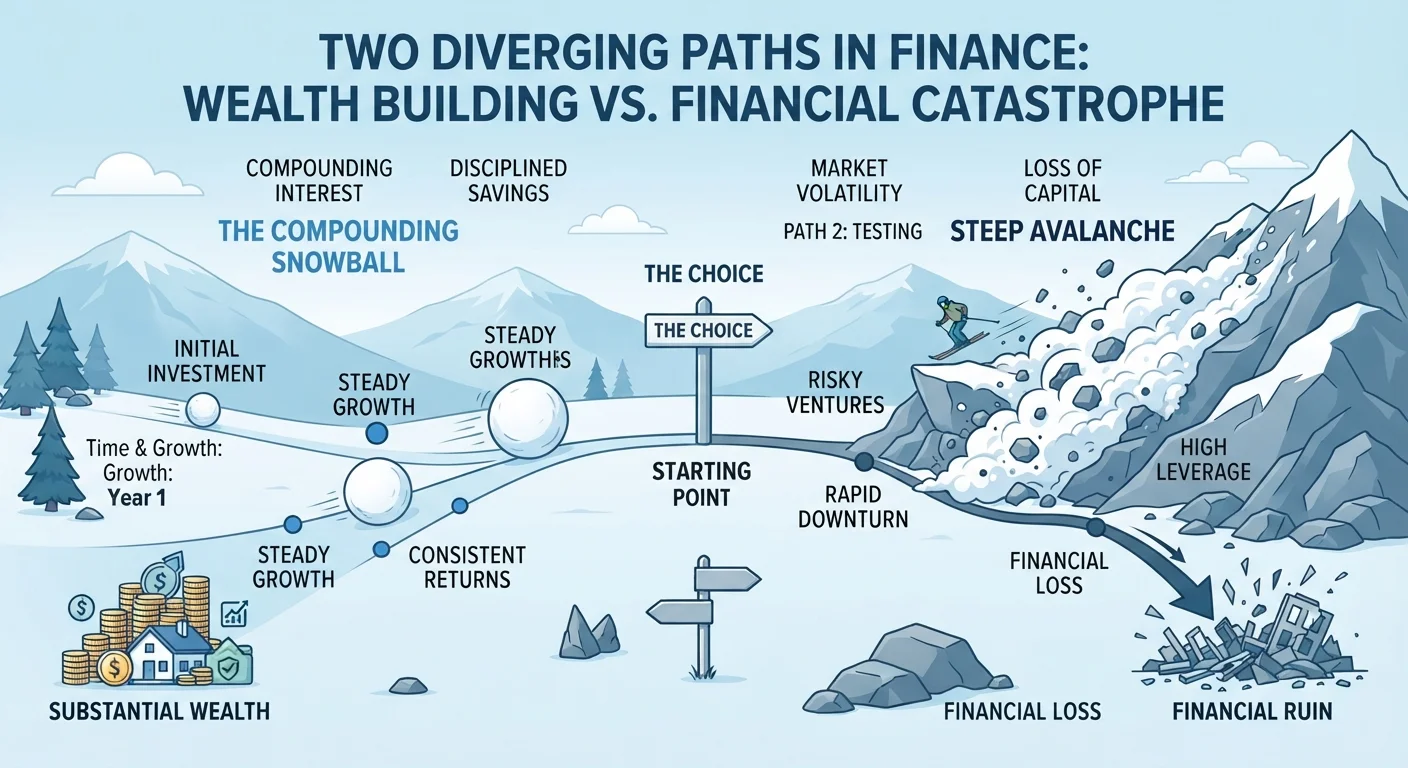
Debt Snowball: You rank your debts from smallest to largest outstanding balance, ignoring interest rates. You attack the smallest balance first. Once it hits zero, you roll its payment into the next-smallest balance. The method's name captures how your payment power compounds: a small snowball rolling downhill gathers more snow and grows larger as it moves.
If you're new to debt concepts like APR or minimum payments, our first-timer's debt overview covers the fundamentals before you choose a strategy.
| Criterion | Debt Avalanche | Debt Snowball |
|---|---|---|
| Payoff order | Highest APR first | Smallest balance first |
| Total interest paid | Lower overall | Typically higher |
| Time to first payoff | Can be longer | Often quicker |
| Motivational structure | Long-term reward focus | Frequent early wins |
| Best when rates differ greatly | Yes - high advantage | Less relevant |
| Complexity | Slightly more tracking needed | Simple to follow |
| Suits personality type | Analytical, patient | Action-oriented, momentum-driven |
The Math: What Each Method Actually Costs
Consider a simplified example with three debts: a $500 medical bill at 0% interest, a $3,000 credit card at 22% APR, and a $7,000 personal loan at 11% APR. Assume you can put $200 per month above your minimums toward debt.
Under the avalanche, you target the 22% credit card first. You pay it off faster and avoid months of high-rate compounding. The 0% medical bill is last because it costs nothing extra to carry.
Under the snowball, you clear the $500 medical bill first - done in about three months - then move to the credit card, then the loan. You pay the same total principal, but the 22% card accrues interest longer, meaning your total interest cost is higher than with the avalanche.
The interest difference between the two methods varies widely based on balances, rates, and how much extra you can pay. In some scenarios it amounts to hundreds of dollars; in others, thousands. Running the numbers using a free online debt payoff calculator (many are offered by nonprofit credit counseling agencies) is worthwhile before committing to a path.
22%+
Typical credit card APR in the US
According to the Consumer Financial Protection Bureau, average credit card interest rates have climbed significantly in recent years, making high-rate debt especially costly to carry.
~$6,000
Average US credit card balance per cardholder
Federal Reserve data indicates that Americans carrying a balance hold roughly this amount, underscoring how meaningful a structured payoff strategy can be.
It is also worth knowing that neither strategy is the only way to restructure debt. Our article on what debt consolidation solves and doesn't explains an alternative approach that may suit some households.
The Psychology: Why Motivation Matters as Much as Math
A mathematically perfect plan you abandon after four months achieves less than an imperfect plan you follow for four years. That is the practical argument for the snowball.
Research published in the Journal of Marketing Research has found that people tackling multiple debts are more likely to eliminate their overall debt when they focus on one account at a time - and that the sense of progress from closing an account can reinforce continued effort. This does not make the snowball universally superior; it means psychology is a legitimate variable in your decision, not a weakness to dismiss.
Some financial educators suggest a hybrid: use the snowball for your first one or two debts to build confidence, then switch to the avalanche once you have momentum. There is no rule against adapting.
Nonprofit Credit Counseling Is an Option
If you are uncertain which method fits your situation, nonprofit credit counseling agencies - such as those accredited by the National Foundation for Credit Counseling (NFCC) - offer free or low-cost budgeting and debt management guidance. They can help you map out a realistic repayment timeline and, in some cases, negotiate with creditors on your behalf. This is general information; outcomes vary by individual circumstance.
If you are wondering whether your debt load requires a more urgent intervention than either method offers, the warning signs your debt is becoming unmanageable article outlines red flags worth reviewing first.
Choosing Your Strategy and Getting Started
Ask yourself two questions. First: how far apart are the interest rates on my debts? If one debt carries 25% APR and another carries 6%, the avalanche's advantage is substantial. If all your debts sit between 8% and 12%, the difference is smaller and motivation may rightly tip the decision.
Second: what has derailed my debt payoff attempts before? If the answer is losing steam, the snowball's quick wins may be the tool that keeps you going.
Once you have chosen a method, follow these steps:
- List all your debts with their balances, minimum payments, and APRs.
- Sort them by your chosen method (highest APR or smallest balance).
- Confirm you can make the minimum payment on every account each month - missing minimums triggers fees and credit score damage.
- Identify how much extra you can realistically direct at your target debt each month.
- Review your progress every three months and adjust if your income or expenses change.
If you are also weighing whether to shift debt into a different product, see our comparison of credit cards vs. personal loans for paying off debt for a discussion of consolidation tools. And understanding the difference between secured and unsecured debt can help you prioritize which accounts carry the most risk if left unpaid.
This article is for general informational and educational purposes only and does not constitute personalized financial or legal advice. For guidance specific to your situation, consider consulting a licensed financial counselor or advisor.