
The Chemistry Happening Inside Your Onion
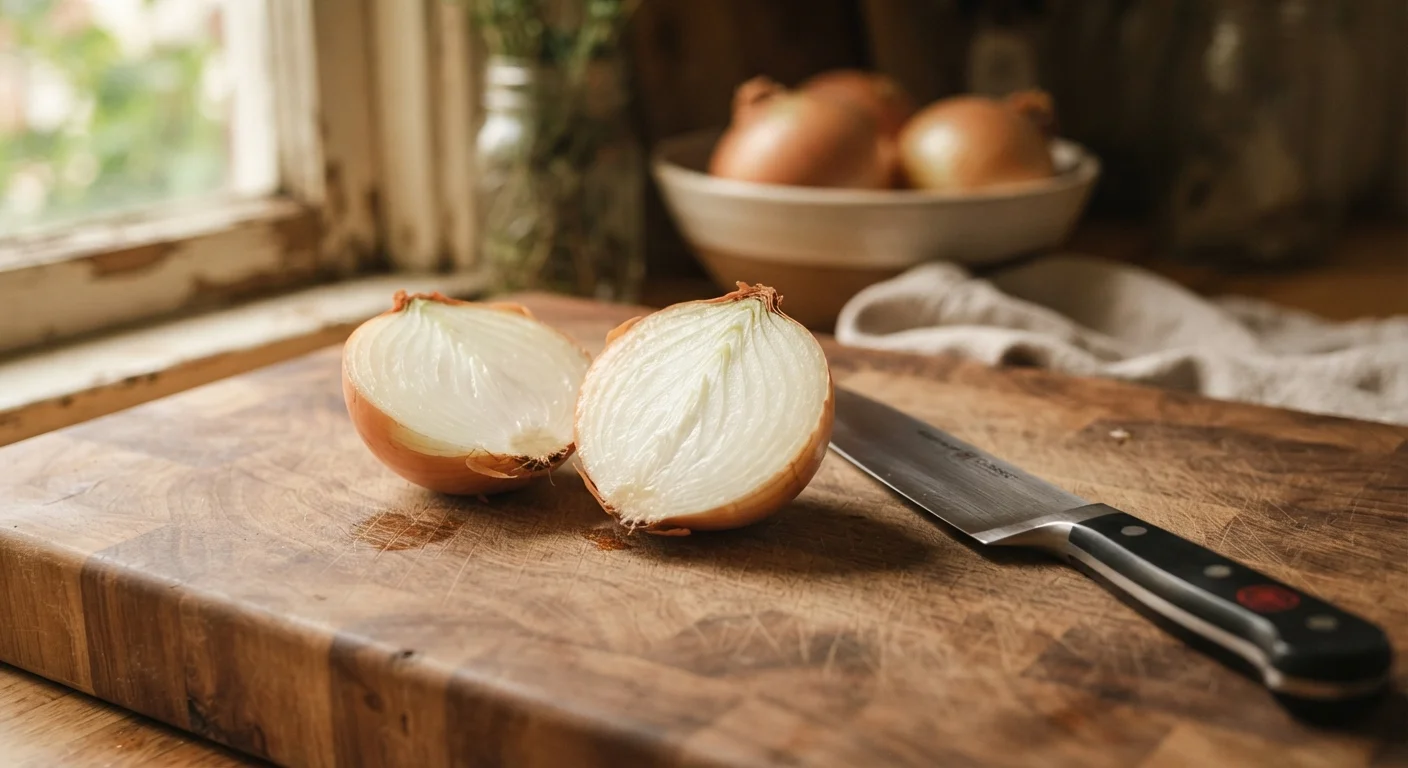
An onion is essentially a chemical defense system. Inside its cells, sulfur-containing amino acid compounds sit safely separated from an enzyme called alliinase. The moment your knife breaks those cell walls, the two meet, triggering a rapid reaction that produces syn-propanethial S-oxide - the lachrymatory factor (LF).
This compound is a gas at room temperature. It rises from the cutting board, reaches your eyes, and dissolves into the tear film on your cornea. That reaction produces a very mild sulfurous acid, and your eyes respond with exactly what they'd do to any irritant: rapid, reflexive tearing.
The process is fast and automatic. Understanding it shifts the question from "why does this happen?" to "how do I slow the reaction down?"
Crying Doesn't Affect Onion Flavor
The lachrymatory factor that irritates your eyes is a separate compound from the flavor and aroma compounds that make onions taste good. Techniques that reduce irritation - chilling, sharp knives, ventilation - do not meaningfully change the flavor of your finished dish.
Why Your Knife Choice Matters More Than You Think
A dull knife doesn't slice - it tears and crushes. Every extra bit of cell damage from a blunt blade means more alliinase released, more reaction, and more gas. A sharp knife makes a clean cut through far fewer cells, dramatically reducing the volume of irritant produced.
This is one of the most impactful and overlooked factors in onion-related tearing. If you haven't honed or sharpened your knife recently, that's likely a significant contributor to your discomfort at the cutting board.
Keep Your Knife Sharp for Less Crying
A quick pass on a honing steel before each use keeps the blade aligned, while sharpening on a whetstone (every few months for regular home cooks) restores a true edge. Both steps together make onion prep noticeably less irritating and safer overall.
Your cutting technique also matters. Work efficiently and confidently - the longer the onion sits cut-side up while you reposition your hand or look for your recipe, the more gas accumulates near your face. Minimize pauses once you've made the first cut.
Practical Techniques That Actually Reduce Tears
Several strategies genuinely help, and each targets a different part of the chemical reaction:
- Chill the onion: Refrigerate it for 15-30 minutes before cutting. Cold temperatures slow enzyme activity, reducing gas output without damaging the onion's texture.
- Improve ventilation: Turn on your range hood or position a small fan to blow air away from your face. Moving air disperses the gas before it reaches your eyes.
- Cut the root last: The root end is enzyme-dense. Keep it intact as a handle while you work through the rest of the onion, then cut it off in the final step.
- Work on a stable, flat surface: Fewer erratic cuts mean fewer ruptured cells. A non-slip cutting board keeps your technique controlled.
~3x
More gas released by a dull knife vs. a sharp one
Food science research on cell rupture in allium cutting demonstrates that blade sharpness significantly affects the quantity of volatile compounds released.
15-30 min
Refrigeration time that slows enzyme activity
Brief chilling is widely recommended by culinary educators as a practical, low-effort method to reduce lachrymatory factor production.
Goggles marketed specifically for onion cutting do work - they create a sealed barrier - but ventilation and a sharp knife combined are usually sufficient for most home cooks.
Choosing Lower-Irritation Onion Varieties
Not all onions are equally aggressive. The sulfur content of an onion is influenced by both genetics and the soil conditions it was grown in. Onions grown in high-sulfur soils absorb more sulfur during growth, which increases the precursor compounds available for the irritating reaction.
If you find yourself consistently overwhelmed by onion irritation, switching to a sweet onion variety for recipes where a milder flavor is acceptable is a straightforward solution. For dishes that need the sharper bite of a yellow or white onion, pair the right variety with good technique.