

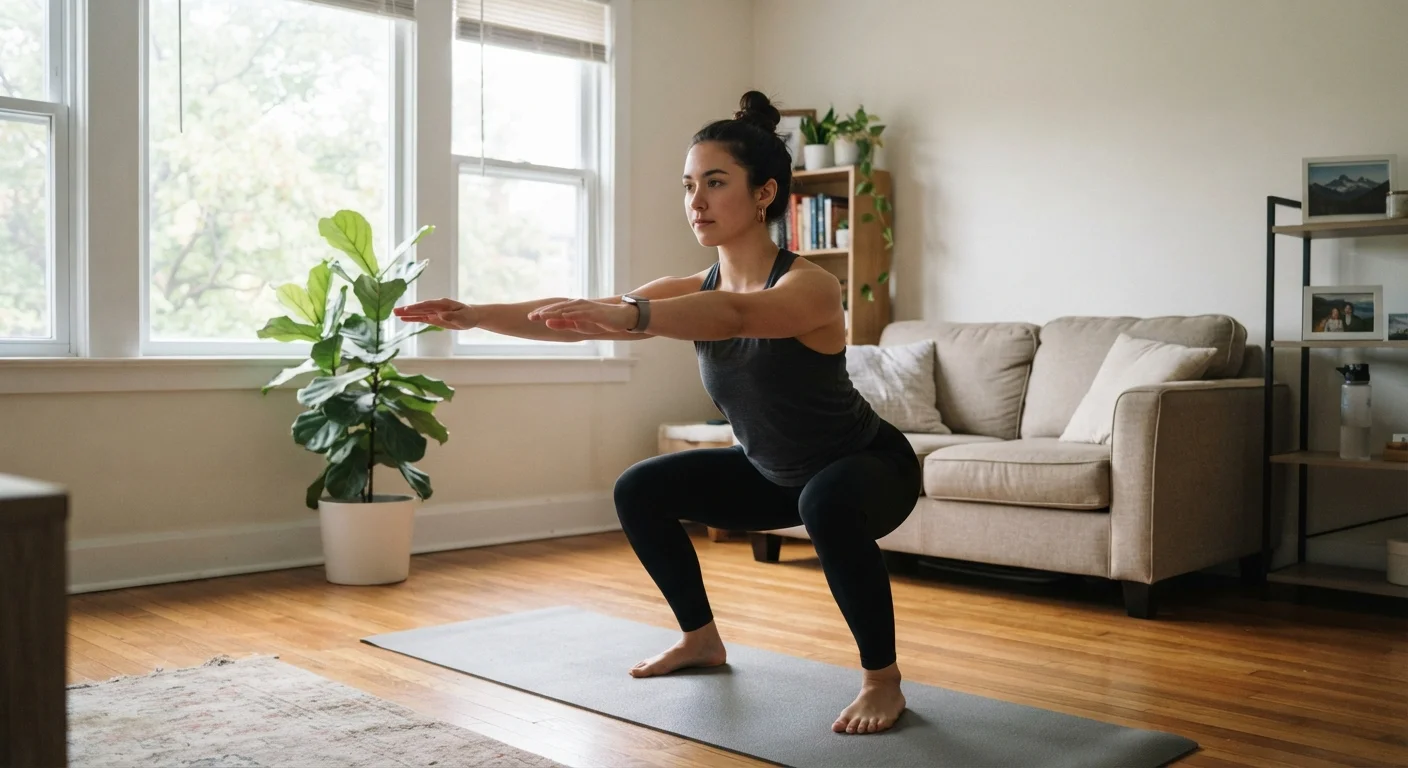
Why Space Shouldn't Determine Your Activity Level
Many people mentally file fitness under "things I'll do when I have more room, more equipment, or more time." But the research on exercise doesn't support that framing. The physical benefits of regular movement - improved cardiovascular health, stronger muscles, better mood regulation - are accessible without a single piece of equipment or a dedicated workout room.
The real barrier is often psychological: a gym-centric culture makes it easy to believe that working out outside of one looks somehow lesser. It isn't. What matters is mechanical load, cardiovascular demand, and consistency - none of which require a squat rack or 1,000 square feet. If you're returning to movement after a break, a small-space routine is actually an ideal entry point: low friction, no commute, completely adjustable to your current fitness level.
Below are seven practical strategies for getting real, effective movement in real-world living conditions.
Master the bodyweight fundamentals first
Push-ups, squats, lunges, glute bridges, and planks are among the most well-researched exercises in existence - and they require nothing but your own body and a few feet of clear floor. A standard yoga mat (roughly 6 by 2 feet) provides enough surface area to complete a full session targeting every major muscle group.
The key is progressive overload: gradually making the movements harder over time. Slow down the tempo, increase reps, shift to more demanding variations (archer push-ups, single-leg squats), or reduce rest periods. Difficulty is built in, not bought.
A yoga mat's worth of floor space is genuinely enough to train every major muscle group.
Use vertical space and walls strategically
Walls are underused training tools. Wall sits build quad and glute endurance without a machine. Incline push-ups using a wall reduce load for beginners, while decline variations add difficulty. Wall-supported single-leg balance drills improve stability and proprioception - the body's sense of its own position - which is particularly valuable as adults age.
Even a door frame can anchor a resistance band if you decide to add one low-cost item down the line. But the wall alone earns its place in a no-equipment routine.
Walls are underused training tools - wall sits, inclines, and balance drills cost nothing.
Incorporate mobility and flexibility work
Mobility - the ability to move a joint actively through its full range - and flexibility are distinct concepts that are often conflated. Understanding the difference matters because each requires a different training approach.
Hip circles, thoracic rotations, ankle circles, and cat-cow stretches are highly effective in tight spaces, require zero equipment, and support joint health over the long term. Dedicating even 10 minutes daily to this work pays dividends in how your body feels and functions - especially if you sit for extended periods.
Daily mobility work in a small space supports joint health and offsets the effects of prolonged sitting.
Stack movement into existing transitions
Non-exercise physical activity - the movement woven into your day outside of formal workouts - contributes meaningfully to overall health. Calf raises while waiting for coffee to brew, a set of squats between video calls, or a standing stretch during a reading break all add up.
This isn't a replacement for structured movement, but it's a powerful complement. Research consistently shows that breaking up prolonged sedentary time has metabolic benefits independent of how much formal exercise a person gets. Everyday movement habits can be as important as scheduled workouts.
Breaking up sedentary time has metabolic benefits independent of your formal exercise sessions.
Use interval-style formats to boost cardiovascular demand
Without a treadmill or open road, raising your heart rate in a small space requires creativity. High-knees, jumping jacks, burpees, mountain climbers, and lateral shuffles (scaled to your available floor space) can all drive cardiovascular demand effectively.
Interval formats - alternating brief periods of higher-intensity effort with short recovery periods - are well-supported by research for improving aerobic capacity and burning energy efficiently. They're adaptable to any fitness level by adjusting work-to-rest ratios. For those interested in lower-intensity cardiovascular training, Zone 2 cardio principles can also be applied through steady marching or step-tapping in place.
Burpees, mountain climbers, and high-knees can drive real cardiovascular demand in any-size room.
Treat short sessions as complete, not partial
The belief that a workout only "counts" above a certain duration is a myth that undermines consistency. A focused 15- or 20-minute session that elevates heart rate and challenges muscles delivers genuine physiological benefit. Evidence supports the idea that shorter, more frequent bouts of activity can be at least as effective as longer, less frequent ones for many health outcomes.
Reframing a short session as complete rather than a compromise removes a significant mental obstacle - particularly on days when a longer window simply isn't available. Combining strength and cardio work in a single short session is one efficient approach.
A focused 15-minute session is complete - not a compromise - when it challenges you appropriately.
Adjust intensity to account for age and recovery needs
Movement needs aren't static. A routine that works well in your 30s may need modification in your 50s or 60s - not because exercise becomes less important (it becomes more so), but because recovery time, joint considerations, and training priorities shift. How exercise needs evolve across adult life is worth understanding at any age.
In a small-space context, this might mean prioritizing balance training, lower-impact variations, or more recovery days between higher-intensity sessions. The goal is sustainable movement over months and years - not maximum output in any single week.
Sustainable movement over years matters more than maximum output in any single week.
Making It a Consistent Habit
The biggest predictor of fitness progress isn't the sophistication of your program - it's how reliably you show up. Small-space workouts remove a number of common friction points: travel time, cost, weather, and gym anxiety. That removal is a genuine advantage worth leaning into.
Consistency Over Intensity Every Time
When space and equipment are limited, the temptation is to compensate with extreme effort. Resist it. Moderate, consistent movement builds far more lasting fitness than sporadic high-intensity sessions followed by burnout or injury. Start with what you can recover from, then build gradually over weeks and months.
If your schedule shifts week to week, a flexible approach matters as much as the exercises themselves. The guide to exercising with an unpredictable schedule offers practical frameworks for maintaining momentum without a fixed routine. And because physical activity and recovery work best alongside sound nutrition, pairing your movement habit with thoughtful eating - even on a budget - compounds the benefit. See healthy eating on a budget for accessible strategies.
This article is for general informational and educational purposes only and does not constitute medical advice. Consult a qualified healthcare professional before starting any new exercise program, particularly if you have existing health conditions or injuries.