
How Each Valuation Method Works
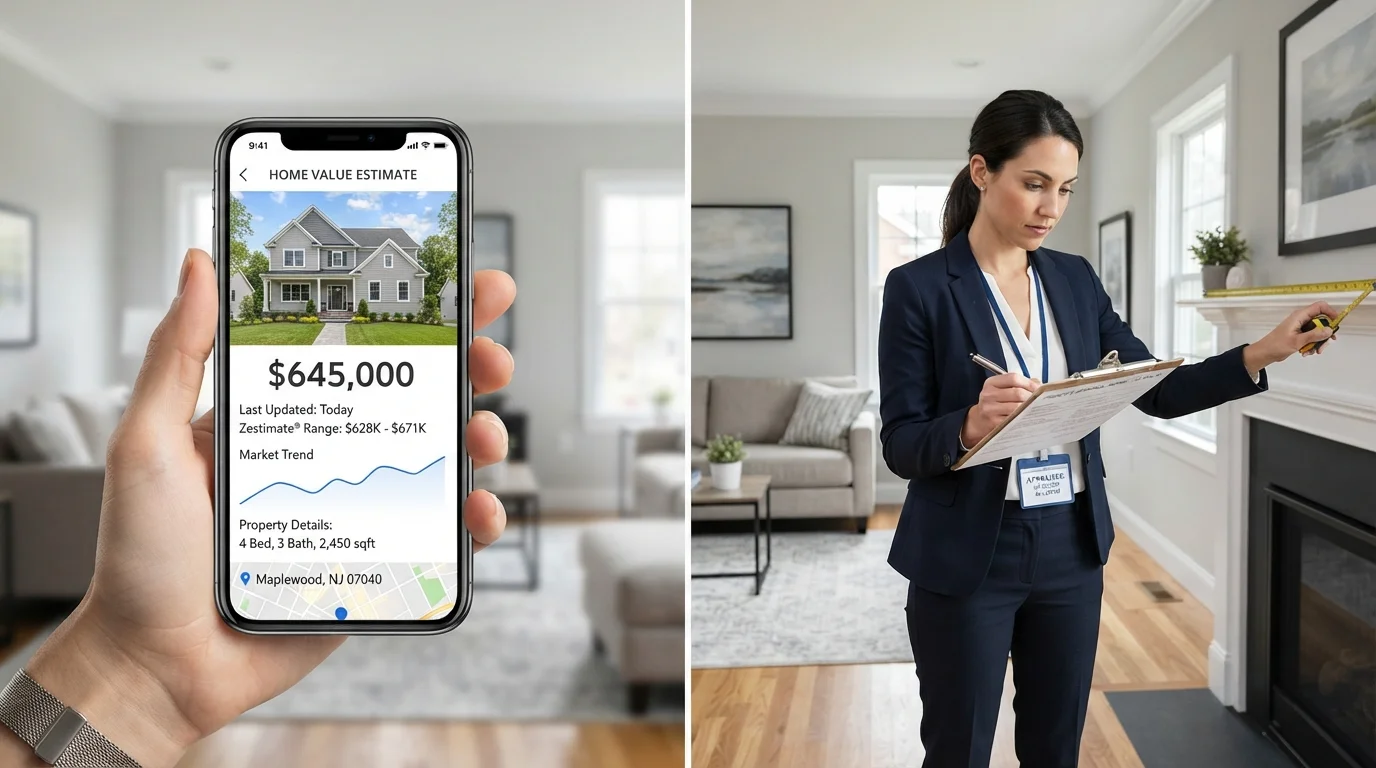
A Zestimate is Zillow's branded automated valuation model (AVM). It draws on publicly available data - tax records, prior sale prices, listed square footage, and nearby comparable sales - and runs that information through a proprietary machine-learning algorithm. The result is generated instantly, at no cost, and updated frequently. Other platforms, including Redfin and Realtor.com, operate their own versions of the same concept.
A professional appraisal is an opinion of value prepared by a state-licensed or state-certified appraiser. The appraiser physically visits the property, documents its condition, measures square footage, notes upgrades or deficiencies, and compares the home to recent arm's-length sales of similar properties - a process known as the sales comparison approach. The resulting report typically runs 10-30 pages and must conform to the Uniform Standards of Professional Appraisal Practice (USPAP). To understand what appraisers specifically look at, see our guide to the factors appraisers weigh.
| Criterion | Zestimate (AVM) | Professional Appraisal |
|---|---|---|
| Cost | Free | Typically $300-$600+ |
| Speed | Instant, updated frequently | Several days to complete |
| Physical inspection | None | Required on-site visit |
| Data sources | Public records, listing data | On-site inspection + comparable sales |
| Accounts for condition/renovations | Limited; relies on recorded data | Yes, with manual adjustments |
| Accepted by mortgage lenders | No | Yes |
| Legal defensibility | None | Yes, meets USPAP standards |
| Accuracy in unique properties | Lower | Higher |
Where the Numbers Diverge - and Why
The core limitation of any AVM is that it cannot see inside your home. A Zestimate does not know that your kitchen was renovated last year, that the roof is 25 years old, or that the garage was converted to living space without a permit. It works with the data it has access to - which, depending on your county's public records, may be incomplete or outdated.
This gap is most pronounced in rural areas, older neighborhoods with wide housing variation, and markets where few sales occur. Zillow itself publishes accuracy statistics, acknowledging that error rates are higher for off-market properties than for homes actively listed with photos and listing data feeding the model.
~2-3%
Zillow's reported median error rate for on-market homes
Zillow publishes its own accuracy statistics; error rates for off-market homes are reported to be considerably higher.
$300-$600+
Typical cost of a single-family home appraisal
Costs vary by property type, size, and geographic market; complex or larger properties generally cost more to appraise.
3+
Minimum comparable sales typically required by an appraiser
Appraisers generally identify at least three recent, similar nearby sales and make manual adjustments to arrive at a value.
Professional appraisers also use comparable sales, but they make manual adjustments for differences in condition, lot size, location, and amenity quality. That judgment layer is something no current algorithm fully replicates. For a deeper look at how algorithmic tools handle this, our article on how automated valuation models work and when to distrust them explains the mechanics and blind spots in detail.
When Each Tool Is - and Isn't - Appropriate
Use an AVM when: you want a free, fast sense of whether a neighborhood's prices are rising or falling, or when you're casually tracking your home's approximate value over time. It's also a reasonable starting point when deciding whether it's worth pursuing a formal appraisal or listing conversation.
Use a professional appraisal when: you're applying for or refinancing a mortgage (lenders require it), settling an estate, resolving a divorce, contesting a property tax assessment, or negotiating a sale price where accuracy carries financial consequence. An appraisal also provides legal defensibility that an AVM simply cannot.
Appraisals Are Opinions, Not Guarantees
Two licensed appraisers evaluating the same property may arrive at slightly different values - both within acceptable professional standards. An appraisal represents a well-supported professional opinion of value at a specific point in time, not a guaranteed or permanent market price. Market conditions can shift the true value of a home after an appraisal is completed, which is why most appraisals are considered valid for only 90-180 days for lending purposes.
It's worth noting that even professional appraisals have limits. Appraised value and market value are related but not identical concepts - and neither is the same as assessed value used for tax purposes. Our overview of assessed, appraised, and market value clarifies how these three figures differ and when each one matters. For a fuller picture of what an appraisal does and doesn't measure, see what a home appraisal actually measures.