
Why the Advertised Price Is Rarely the Final Price
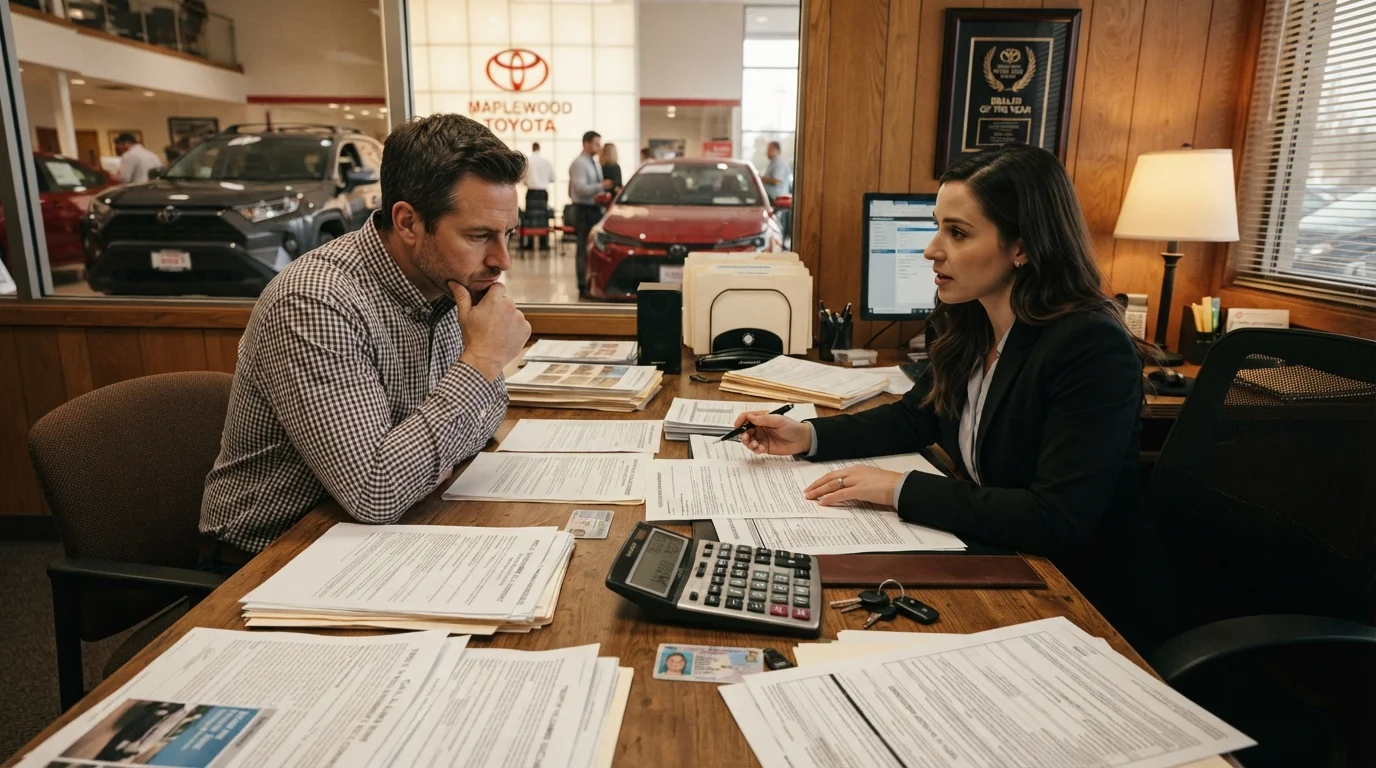
A car's advertised price - the MSRP or dealer asking price - is a baseline, not a ceiling. By the time you sign paperwork, a significant number of additional charges typically stack on top. Understanding each one ahead of time puts you in a far stronger position to question, negotiate, or at least budget accurately.
| Typical doc fee range | $100-$700+ (Varies by state; some states cap maximum amounts) |
| Sales tax range by state | 0%-9%+ (State and local rates; trade-in allowances may reduce taxable amount) |
| Title and registration fees | $150-$500 (most states) (Can be higher for luxury or heavy vehicles) |
| Destination charges (new vehicles) | $400-$1,700+ (Set by the manufacturer; non-negotiable) |
| Interest on $30K loan at 7% / 60 mo. | ~$5,600 total (General calculation; actual cost depends on rate and term) |
These costs aren't hidden in a deceptive sense - they're disclosed in the contract - but they're rarely featured prominently in ads. Shoppers who focus only on the sticker price often leave the dealership surprised by a total that's thousands higher than expected. For a broader look at how common car-buying assumptions can cost you, see car-buying myths that cost shoppers real money.
The Major Cost Categories to Watch
Each of the following categories adds real dollars to what you'll pay. Some are fixed by law; others are variable and sometimes negotiable.
Sales Tax
Sales tax on a vehicle purchase is calculated as a percentage of the sale price and varies widely by state - from zero in states like Oregon and Montana to over 9% in some localities. On a $35,000 vehicle, a 7% tax rate adds $2,450 before anything else. Some states also factor in trade-in value, which can reduce the taxable amount.
Title and Registration Fees
These government fees transfer legal ownership to you and register the vehicle with your state's DMV. Costs vary by state and are sometimes tied to the vehicle's value or weight. Expect a combined range of roughly $150-$500 in most states, though it can run higher for luxury or heavier vehicles.
Documentation (Doc) Fees
Dealerships charge a documentation fee - often called a "doc fee" - for processing the paperwork. Some states cap this fee; others do not, meaning it can range from under $100 to over $700 depending on the dealer and state. Unlike taxes, doc fees are sometimes negotiable or can offset other line items in your deal.
Dealer Add-Ons
Paint protection, fabric sealant, nitrogen-filled tires, window tinting, GPS tracking - these are frequently added to the vehicle before you arrive on the lot and presented as installed features. You typically aren't required to buy them, but some dealers resist removing them. Know which add-ons, if any, you actually want before entering negotiations.
Destination and Delivery Charges
Automakers charge a fixed fee to ship a vehicle from the factory to the dealer. This charge appears on the Monroney sticker (the federally required window label) and is generally non-negotiable - it's set by the manufacturer, not the dealer. Amounts typically range from a few hundred to over $1,500 for larger vehicles.
Extended Warranties and GAP Insurance
Finance offices commonly offer extended service contracts and Guaranteed Asset Protection (GAP) insurance - which covers the difference between your loan balance and insurance payout if the car is totaled. Both can have genuine value, but both are also profit centers. Shop these independently before your dealership visit; you are not required to purchase them through the dealer.
MSRP
Manufacturer's Suggested Retail Price - the price the automaker recommends the dealer charge. It does not include taxes, fees, or dealer add-ons, and it is not always the actual transaction price.
Doc Fee
A documentation fee charged by the dealership for processing the sale's paperwork. It varies significantly by dealer and state, and some states cap the maximum amount a dealer can charge.
GAP Insurance
Guaranteed Asset Protection insurance covers the gap between what you owe on a vehicle loan and what your auto insurer pays out if the car is totaled or stolen. It's most relevant when you have a small down payment or long loan term.
Monroney Sticker
The federally required window label on new vehicles showing the MSRP, fuel economy ratings, installed options, and the manufacturer's destination charge. It is standardized and cannot be removed by the dealer before sale.
Destination Charge
A fixed fee set by the manufacturer to cover shipping the vehicle from the assembly plant to the dealership. It appears on the Monroney sticker and is non-negotiable.
Insurance and Financing Costs
Two costs that extend beyond the sale itself deserve attention:
Insurance Premium Increases
Switching to a newer, higher-value vehicle almost always raises your insurance premium. The increase depends on the vehicle's value, repair costs, safety ratings, and your driving history. Request an insurance quote on any vehicle you're seriously considering before you commit - this gives you an accurate picture of your true monthly cost of ownership.
Loan Interest
If you're financing, the interest paid over the life of the loan is a significant cost that's easy to overlook when focused on monthly payments. On a $30,000 loan at 7% APR over 60 months, total interest paid is roughly $5,600. A lower purchase price - or a shorter loan term - reduces this substantially. Improving your credit score before applying is one of the most effective ways to reduce your interest rate.
Negotiate the Purchase Price, Not Just the Monthly Payment
Dealers can manipulate monthly payments by adjusting loan terms - stretching the loan to 72 or 84 months lowers the monthly figure but increases total interest paid significantly. Always negotiate the out-the-door price first, then determine financing separately. This approach gives you a clear view of what you're actually paying for the vehicle.
The pattern of advertised-price-versus-true-total isn't unique to car buying - it shows up in real estate, travel, and rentals too. See how it plays out in home purchases: costs beyond the purchase price that buyers often underestimate.