
What's Actually Happening Inside the Meat
When meat hits a hot pan, grill, or oven, two things happen simultaneously: the exterior browns through the Maillard reaction, and the internal muscle fibers begin to contract from the heat. That contraction squeezes moisture - primarily water and dissolved proteins - inward, toward the cooler center of the cut.
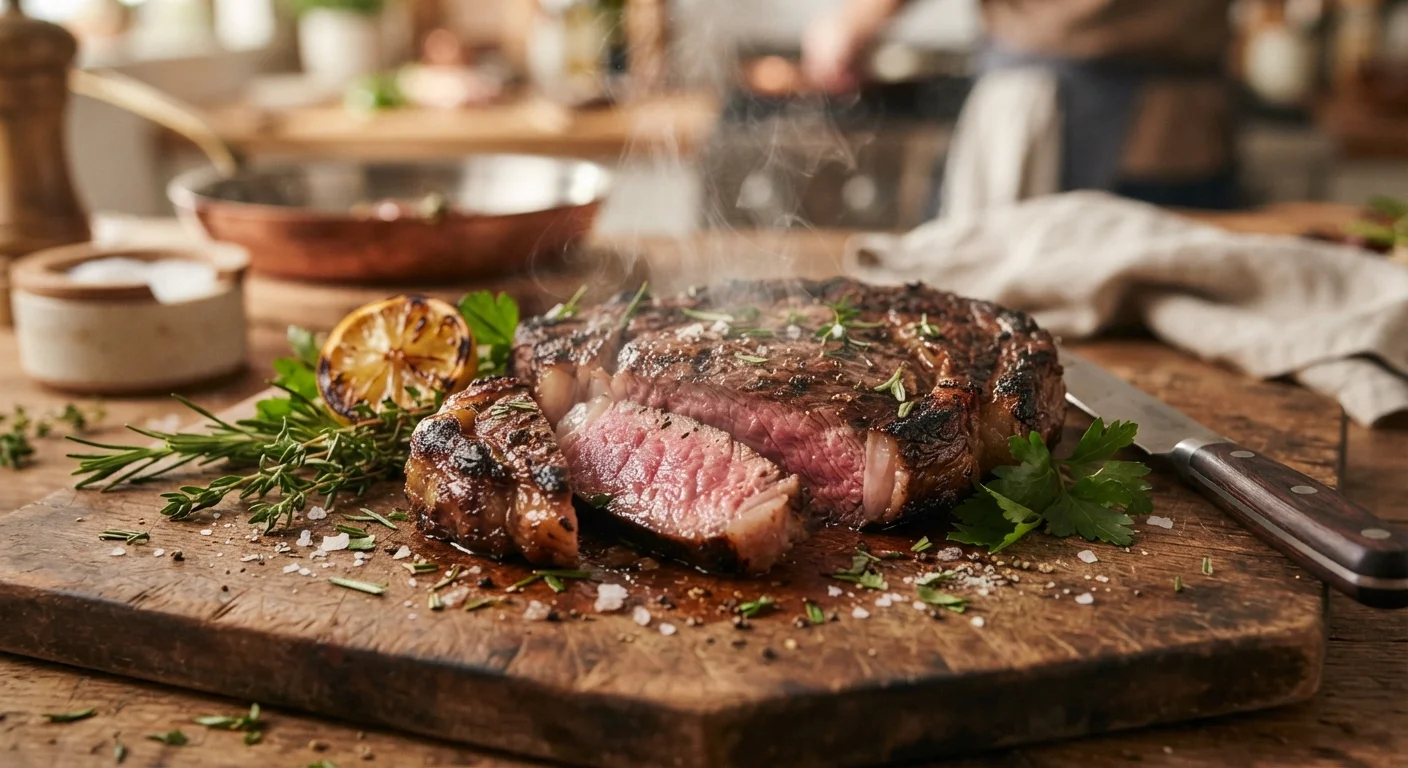
By the time you pull that steak or chicken breast off the heat, its moisture is unevenly distributed. The center is relatively wet; the outer layers are comparatively dry and tense. If you cut into it at this moment, that pressurized liquid simply flows out onto the board, not into your mouth.
Resting gives the temperature gradient time to equalize. As the hot exterior and cool center approach the same temperature, the contracted fibers relax and fluid migrates back outward. The moisture spreads more evenly through the meat's structure. When you slice it now, each piece holds onto far more of that liquid - and tastes noticeably juicier as a result.
This Applies Beyond Beef
The physics of moisture redistribution affect all muscle-based proteins - pork, lamb, chicken, and even dense fish like tuna or swordfish steaks. The principle scales with thickness and cooking temperature, so the same underlying logic applies regardless of what protein you're working with.
Carryover Cooking: The Hidden Part of Resting
Resting isn't just passive waiting - something active is still happening. Residual heat stored in the outer layers of the meat continues to move inward even after you remove it from the heat source. This is called carryover cooking, and it can raise the internal temperature by anywhere from 3°F to 10°F depending on the thickness of the cut and how high the cooking temperature was.
This matters practically. If you want a steak to reach a final internal temperature of 135°F for medium-rare, pulling it off the heat at 127°F and allowing carryover to do the rest is standard practice among experienced cooks. Cutting immediately would interrupt that process - and likely mean overcooking the meat on the next attempt to get it to temperature.
For larger roasts, carryover is even more significant. A thick prime rib pulled from the oven at 120°F may climb to 130°F or beyond while resting. Understanding this dynamic is part of what separates reliably good results from inconsistent ones - and it's explored further in the techniques worth learning for everyday cooking.
~10°F
Average carryover temperature rise in thick cuts
Food science educators commonly cite a range of 5-10°F of carryover rise for larger roasts pulled from high-heat environments.
Up to 40%
More juice retained with adequate resting
Culinary research and cooking science sources have demonstrated that rested meat can retain significantly more moisture when cut compared to meat sliced immediately after cooking.
How Long to Rest Different Cuts
Resting time scales with mass. Bigger cuts store more heat, continue cooking longer, and need more time for redistribution to complete. Here's a practical framework:
- Thin steaks and chops (under 1 inch): 2-3 minutes is sufficient.
- Standard steaks and chicken breasts: 5-8 minutes covers most situations.
- Thick roasts and whole birds: 15-25 minutes, loosely tented with foil to retain warmth without steaming the skin or crust.
One common myth worth addressing: resting does not mean the meat gets cold. Residual heat keeps the interior warm well within the resting window, especially with a foil tent. If you've heard that resting is just a timing trick chefs use to pace their kitchen, that's only half the story - the kitchen myths article unpacks several similar misconceptions that can trip up home cooks.
Set a Timer, Not a Guess
Rather than eyeballing when resting is 'done,' simply set a phone timer based on the cut's thickness the moment you pull it from heat. This removes decision fatigue and keeps you from cutting in too early. Pairing this with a reliable instant-read thermometer removes almost all guesswork from meat cookery.
Practical Tips for Getting It Right
Applying this knowledge consistently is straightforward once you shift the habit. Here are the most useful adjustments to make:
- Pull slightly early. Account for carryover cooking when deciding when to remove meat from the heat. Use an instant-read thermometer so you're not guessing.
- Use a warm plate or board. A cold surface accelerates heat loss. Running your cutting board under warm water and drying it before resting a steak helps maintain temperature.
- Tent, don't wrap. Loosely drape foil over the meat rather than crimping it tightly. Tight wrapping traps steam and softens browning you worked to develop.
- Resist the urge to cut. The biggest obstacle is impatience. Setting a simple timer removes the temptation.
Understanding why resting works - not just that it does - makes it easier to apply across different proteins and situations. That principle of understanding the why behind a technique is central to cooking confidently without rigid recipes.