
How Extraction Method Shapes Your Cup
Every coffee brewing method is essentially a controlled extraction: hot water passes over or through ground coffee, pulling out soluble compounds that create flavor, aroma, and body. The variables - water temperature, contact time, grind size, and filter type - determine which compounds end up in your cup and in what proportion.
Understanding these mechanics makes it easier to troubleshoot a disappointing brew. If your coffee tastes harsh or flat, the method itself may be part of the equation. For a deeper look at flavor problems, see why your coffee tastes bitter for common culprits and fixes.
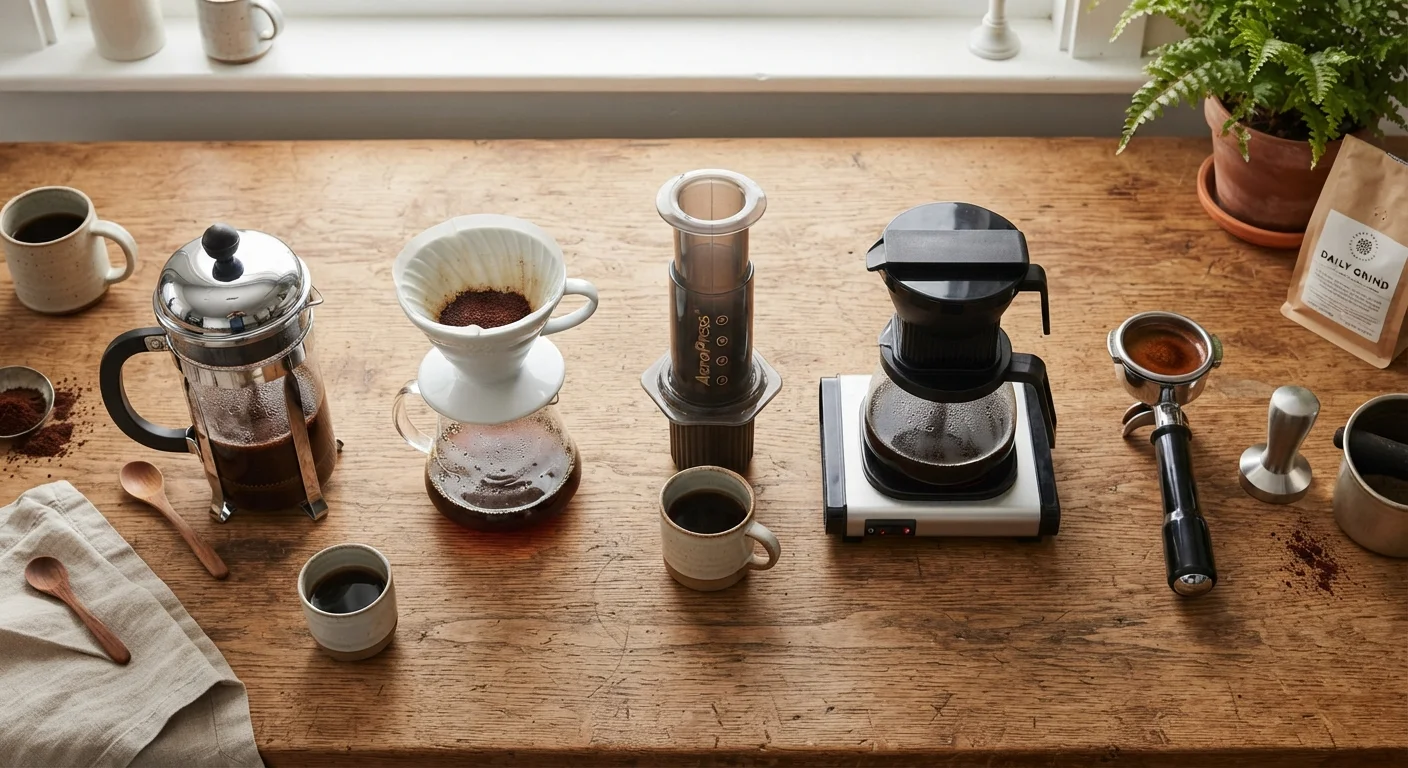
The five methods compared here - French press, pour-over, AeroPress, drip, and espresso - cover the range most home brewers will encounter.
| French Press | Pour-Over | AeroPress | Drip Machine | Espresso | |
|---|---|---|---|---|---|
| Brew Time | ~4 minutes | 3-5 minutes | 1-2 minutes | 5-10 minutes | 25-30 seconds |
| Skill Level Required | Low-Medium | Medium-High | Low-Medium | Low | High |
| Body / Texture | Full, heavy | Clean, light | Smooth, medium | Medium | Thick, concentrated |
| Equipment Cost (general) | Low | Low-Medium | Low | Low-Medium | Medium-High |
| Grind Sensitivity | Coarse | Medium-fine | Flexible | Medium | Very fine, precise |
| Filter Type | Metal mesh | Paper | Paper or metal | Paper | None (pressurized) |
French Press and Pour-Over: Immersion vs. Percolation
French press is an immersion method: coarse grounds steep in hot water for about four minutes, then a metal mesh plunger separates them. Because no paper filter is used, oils and fine particles remain in the cup, giving French press coffee a heavier body and a somewhat sediment-forward texture. It rewards patience but forgives inconsistency in pouring technique.
Pour-over (using a dripper like a V60 or Chemex) is a percolation method: hot water is poured slowly and steadily over grounds held in a paper filter. The filter removes oils and fines, producing a cleaner, brighter cup that highlights a coffee's individual characteristics - acidity, floral notes, or fruit tones. Grind consistency and pour speed matter significantly here. If you're curious about how the coffee's origin and roast interact with brewing, what roast level does to your coffee is a useful companion read.
Match Your Grind Size to Your Method
Using the wrong grind size is one of the most common brewing mistakes. French press needs a coarse grind to prevent over-extraction during the long steep; pour-over works best with a medium-fine grind; espresso demands a very fine, consistent grind. A burr grinder - rather than a blade grinder - produces a more even particle size and makes a meaningful difference in cup quality across all methods.
AeroPress and Drip: Versatility vs. Convenience
AeroPress combines immersion and pressure in a compact plastic chamber. Grounds steep briefly, then you press a plunger to push water through a small paper or metal filter. Total brew time is under two minutes. The AeroPress is widely considered one of the most forgiving and experiment-friendly brewers available - variables like steep time, water temperature, and grind can be adjusted dramatically without ruining the cup. It's also compact enough for travel.
Drip machines automate the pour-over process: a heating element heats water, which then flows through grounds in a paper filter basket. Quality varies considerably by machine - water temperature and shower-head distribution affect extraction significantly. A well-designed drip machine, however, can produce excellent coffee with almost no active effort, making it the default choice for busy households. For readers just exploring quality coffee for the first time, getting started with specialty coffee offers grounded context without the jargon overload.
Espresso: Pressure Extraction and Concentrated Flavor
Espresso differs fundamentally from the other four methods: it uses pressurized hot water - typically around 9 bars - forced through finely ground, tightly packed coffee in 25-30 seconds. The result is a small, concentrated shot (roughly 1-2 ounces) topped with crema, an emulsified layer of oils and CO₂ bubbles.
Because the extraction is so compressed, espresso is exceptionally sensitive to grind size, dose, and tamp pressure. Small deviations produce noticeably different results. Espresso also forms the foundation of lattes, cappuccinos, and Americanos, giving it versatility that other methods lack at the output stage.
Home espresso machines range from manual levers to semi-automatic to fully automatic super-automatics, each offering a different trade-off between control and convenience. For readers who prefer a cold, low-acid coffee experience rather than concentrated hot shots, cold brew vs. iced coffee explains another entirely different approach to extraction.
~400 billion
Cups of coffee consumed globally each year
Coffee is one of the most widely consumed beverages in the world, according to general trade data cited by the International Coffee Organization.
9 bars
Pressure used in espresso extraction
The Specialty Coffee Association identifies 9 bars of atmospheric pressure as the standard for espresso extraction.