
What Happens Inside the Roaster
Green coffee beans are essentially flavorless - the familiar aroma and taste of coffee develop entirely during roasting. As temperature rises, moisture evaporates and the beans undergo rapid chemical changes. Sugars caramelize, proteins react to form hundreds of flavor compounds, and carbon dioxide builds up inside the bean until it cracks open - a stage roasters call the "first crack."
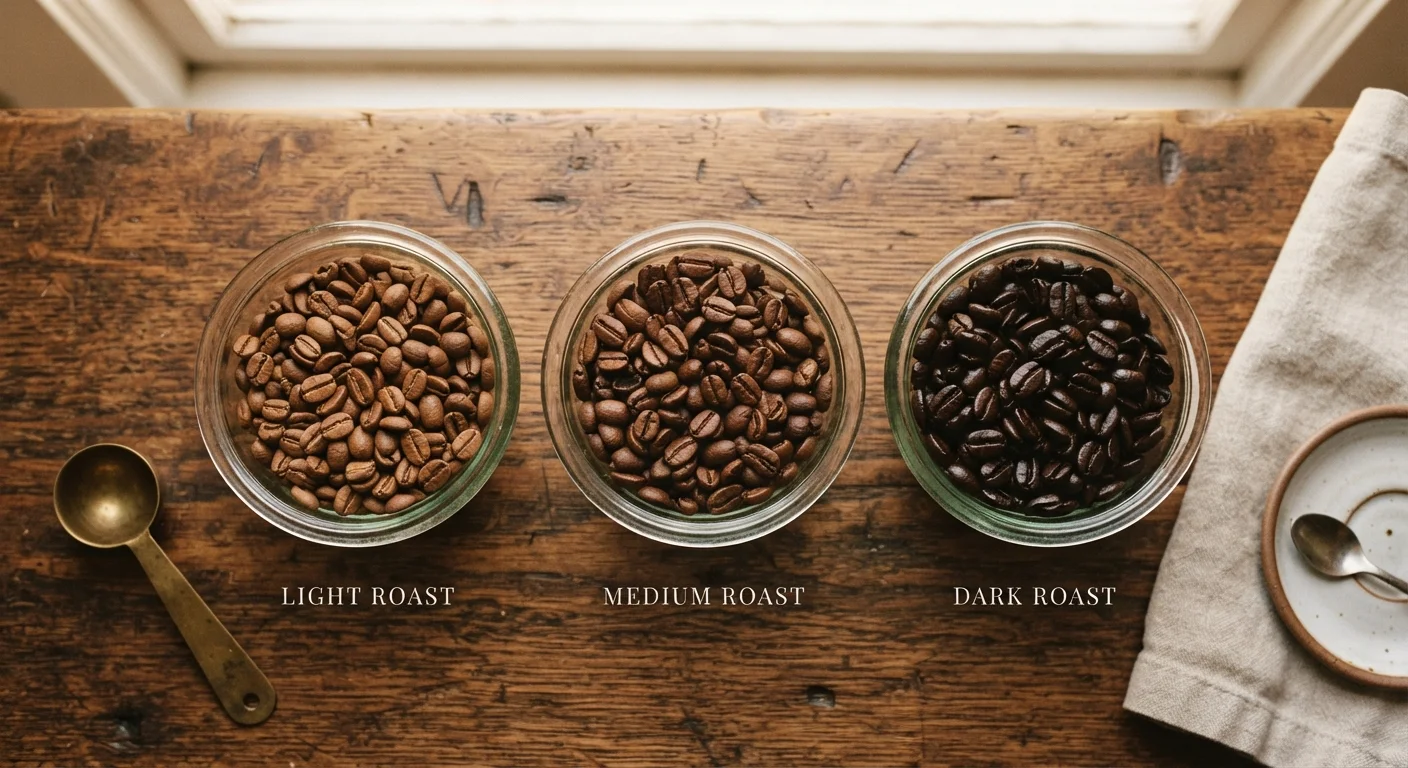
Roasters control roast level by deciding when to stop applying heat. Stopping shortly after first crack produces a light roast. Letting the beans continue into a second crack, or beyond, produces a dark roast. Medium roasts fall somewhere in between. The whole process typically takes 8-15 minutes in a commercial drum roaster.
Roast Names Are Not Standardized
"Light," "medium," and "dark" have no universally agreed-upon definitions in the coffee industry. One roaster's "medium" may be another's "light." Terms like "city roast," "full city," "French roast," and "Italian roast" are also used but vary by company. When in doubt, look at the bag's flavor notes or ask at the counter - those are more reliable guides than the roast label alone.
Light Roast: Bright, Fruity, and Bean-Forward
Light roasts preserve the most of the bean's original character - the flavors shaped by its growing region, soil, altitude, and processing method. Depending on the origin, you might taste notes of citrus, berry, stone fruit, or even floral hints. The body (that sense of weight in your mouth) tends to be lighter and more tea-like.
Acidity is most pronounced in light roasts, giving them a lively, sometimes tangy quality. If you've ever tried a pour-over from a specialty café and tasted something almost juicy, that's likely a light roast at work. For more on how brewing interacts with roast, see our guide to coffee brewing methods.
Dark Roast: Bold, Smoky, and Roast-Driven
As beans roast longer, origin flavors give way to flavors created by the roasting process itself - think dark chocolate, caramel, smoke, and low-acid earthiness. The bean's surface becomes oily from released compounds, and body becomes fuller and heavier on the palate.
Dark roasts are often described as "stronger," but that's more about flavor intensity than caffeine content. The extended heat actually breaks down some caffeine and many of the chlorogenic acids responsible for acidity. If you find highly acidic coffees hard on your stomach, a darker roast may feel more comfortable - as may cold brew, which also produces low-acid results through a very different method.
Try the Same Bean at Different Roast Levels
If you want to understand what roasting actually does to flavor, look for a roaster that offers the same coffee bean at two different roast levels. Tasting them side by side isolates the roast variable and makes the flavor differences immediately clear - it's one of the most instructive experiments a home coffee drinker can do.
The Caffeine Question
The belief that dark roast is stronger in caffeine is one of the most persistent myths in coffee. In reality, the difference is modest and depends on how you measure. By weight, light roast edges ahead because caffeine degrades slightly during longer roasting. By volume - the way most home brewers measure with a scoop - the gap narrows considerably because dark roast beans are less dense and take up more space per gram.
For most everyday drinkers, the practical caffeine difference between roast levels is negligible. Your cup size, brew ratio, and extraction time have a far greater effect on how much caffeine ends up in your mug. Our reference on caffeine in common drinks puts coffee's caffeine in broader perspective.
~95mg
Average caffeine per 8 oz brewed coffee
According to the FDA, brewed coffee typically contains 80-100 mg of caffeine per 8-ounce cup, regardless of roast level.
~200°F
Typical first crack temperature in roasting
First crack - the point that separates light from medium roasts - generally occurs around 196-205°F (91-96°C) in the roasting drum.
~30%
Weight lost by coffee beans during roasting
Green coffee beans lose roughly 15-25% of their weight as moisture and CO₂ during roasting, with dark roasts losing the most mass.
Roast Level and Bitterness
Bitterness in coffee has two main sources: the roasting process and brewing errors. Dark roasts naturally develop more bitter-tasting compounds, but a light roast can also taste harsh if it's brewed incorrectly - for example, with water that's too hot or a grind that's too fine. If your cup is unpleasantly bitter regardless of roast level, brewing variables are often the real culprit. Our article on why coffee tastes bitter walks through the most common causes and fixes.
Medium roasts sit in a useful middle ground: enough roast development to mellow acidity and add body, without the pronounced bitterness of a very dark roast. They're a reliable default for drip brewers and espresso alike.
Choosing the Roast That Works for You
No roast level is objectively superior - each suits a different preference and purpose. A good starting framework: if you enjoy bright, complex flavors and don't mind some tartness, explore light roasts from interesting origins. If you want a bold, low-acid cup with a heavy body, dark roasts deliver that reliably. Medium roasts are the most versatile and the easiest place to begin if you're still figuring out what you like.
Roast freshness also matters. Regardless of level, coffee tastes best within a few weeks of its roast date. Look for bags with a printed roast date rather than a vague "best by" date. For a broader introduction to navigating coffee choices, see our guide to getting started with specialty coffee.