
How Each Financing Path Works
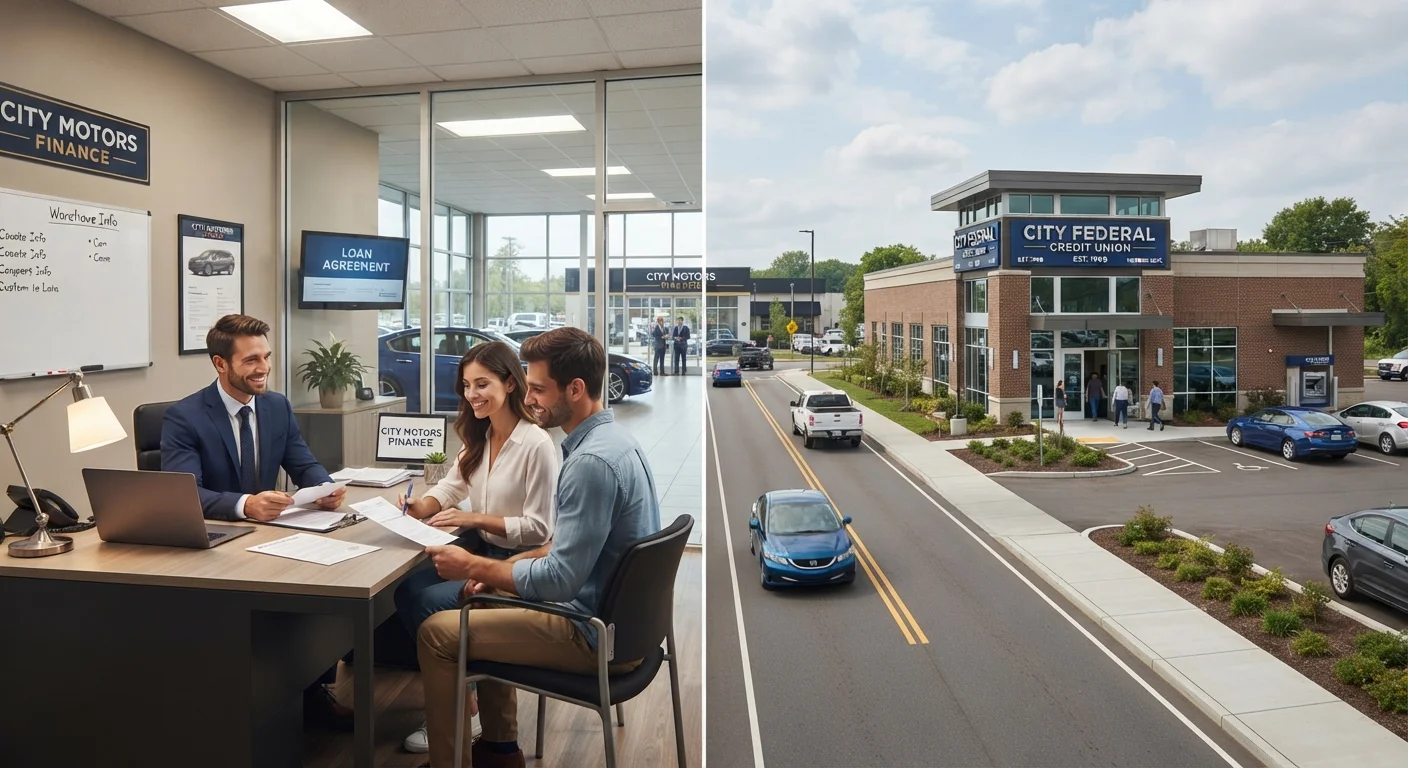
When you finance through a dealership, the dealer submits your application to one or more lenders - banks, captive finance arms (the automaker's own lending division), or credit unions - then presents you with an offer. What many buyers don't realize is that dealers are typically permitted to mark up the interest rate above what the lender actually approved. That spread goes to the dealer as profit. You may never see the lender's original rate.
When you finance through your own bank or credit union, you apply directly and receive a pre-approval letter stating your approved amount and rate. You bring that to the dealership as a cash-equivalent offer. If the dealer wants your business, they either match it, beat it, or you use your pre-approval. Either way, you're negotiating from a defined baseline. For a deeper look at the mechanics behind the numbers, see our guide to how car loans actually work.
| Criterion | Dealer Financing | Bank / Credit Union |
|---|---|---|
| Convenience | High - handled on-site | Requires separate application step |
| Rate transparency | Low - markup often hidden | High - you see the actual rate |
| Rate competitiveness | Variable; promo rates can be excellent | Often lower, especially credit unions |
| Negotiating leverage | Dealer controls the conversation | Pre-approval gives buyer control |
| Lender access | Multiple lenders via dealer network | Single lender per application |
| Promotional rates | Available through captive lenders | Not available |
| Best for credit-challenged buyers | Sometimes more options available | Depends on the institution |
The Real Cost Difference
The difference between a dealer-marked-up rate and a direct lender rate can seem small on paper - perhaps half a percentage point - but it compounds across a 48- to 72-month loan. On a $35,000 vehicle financed for 60 months, a 1% rate difference can add up to several hundred dollars in extra interest over the loan's life. The longer the term, the more that gap widens.
~1-2%
Typical dealer financing markup over lender rate
Industry analysts and consumer finance educators commonly cite dealer rate markups in this range, though actual figures vary by lender agreement and state regulation.
60-72 months
Most common new-car loan terms in the US
Per Experian's State of the Automotive Finance Market reports, the majority of new vehicle loans are now structured over five to six years.
Lower APR
Credit unions vs. banks on auto loans
The National Credit Union Administration (NCUA) consistently reports that credit union auto loan rates average below those of commercial banks.
Credit unions, in particular, are worth contacting before you visit a dealership. As member-owned nonprofits, they often carry lower overhead and pass savings along in the form of lower rates. Many also offer auto loan pre-approval without a hard credit pull during the initial inquiry phase - though a hard inquiry will occur once you formally apply.
When Dealer Financing Actually Makes Sense
Dealer financing isn't always the worse deal. Two scenarios where it can legitimately work in your favor:
- Manufacturer promotional APR: Automakers periodically offer subsidized rates - sometimes as low as 0% - through their captive lenders. These aren't available anywhere else. If you qualify and the vehicle price isn't inflated to compensate, this can be the lowest-cost option. Read the fine print carefully; promotional terms often require shorter loan periods and strong credit scores.
- Thin credit history: If your credit profile is limited, dealer finance departments sometimes have access to a broader range of lenders, including subprime specialists, than a single bank would. That said, the rate on a subprime loan will be high regardless of source - so focus on improving your credit before purchasing if at all possible.
Be aware of common add-ons that can quietly inflate your financing cost. Our article on dealer add-ons that are often not worth the cost covers what to watch for in the finance office.
The Strategic Case for Pre-Approval
Arriving at a dealership pre-approved changes the dynamic of the entire transaction. You've already separated two distinct negotiations: what you pay for the car, and what you pay to borrow the money. Dealers prefer to bundle these together - it gives them more levers to pull. A pre-approval letter removes one of those levers.
Pre-approval also gives you a hard deadline for rate-shopping. Most lenders treat multiple auto loan inquiries within a short window (typically 14-45 days, depending on the credit scoring model) as a single inquiry, so rate-shopping across several lenders has minimal credit score impact. Use that window. If you want to understand how the dealership side of this negotiation works, see our guide to negotiating at a dealership without feeling outmatched.
Rate Shopping and Your Credit Score
Many buyers hesitate to apply to multiple lenders because they worry about credit score damage. In practice, most credit scoring models - including FICO and VantageScore - treat multiple auto loan inquiries made within a short window (often 14 to 45 days) as a single inquiry. This means you can shop across several banks and credit unions with minimal score impact. Start your rate search before visiting any dealership.
This article is for general informational purposes only and does not constitute personalized financial or legal advice. Consult a qualified financial professional regarding your specific situation.