
Why Tire Myths Are More Than Just Trivia
Tires are the only part of your vehicle that actually touches the road, yet tire care is one of the most myth-riddled areas of everyday driving. Misplaced confidence in half-truths can quietly shorten tire life, increase fuel costs, and - more seriously - reduce your ability to stop or steer in an emergency.
The myths below are pervasive precisely because they contain a grain of logic. Understanding why they're wrong is more useful than simply being told they are. See how these misconceptions fit into the broader pattern of neglect covered in our guide on how skipping routine maintenance leads to bigger repair bills.
Myth
Inflate your tires to the pressure printed on the tire sidewall.
Fact
That number is the tire's maximum allowable pressure, not the recommended operating pressure for your vehicle.
The figure molded into the tire sidewall - often 44 or 51 PSI - represents the highest pressure the tire is engineered to hold safely, not the pressure at which it should be run. Your vehicle's correct operating pressure is determined by the automaker based on weight distribution, suspension design, and ride quality. That specification is printed on the sticker inside the driver's door jamb and in your owner's manual. Running tires at or near their maximum pressure causes the center of the tread to wear prematurely, reduces the contact patch with the road, and produces a harsher, less controlled ride.
Myth
If the tire looks fine and feels firm, the pressure is probably okay.
Fact
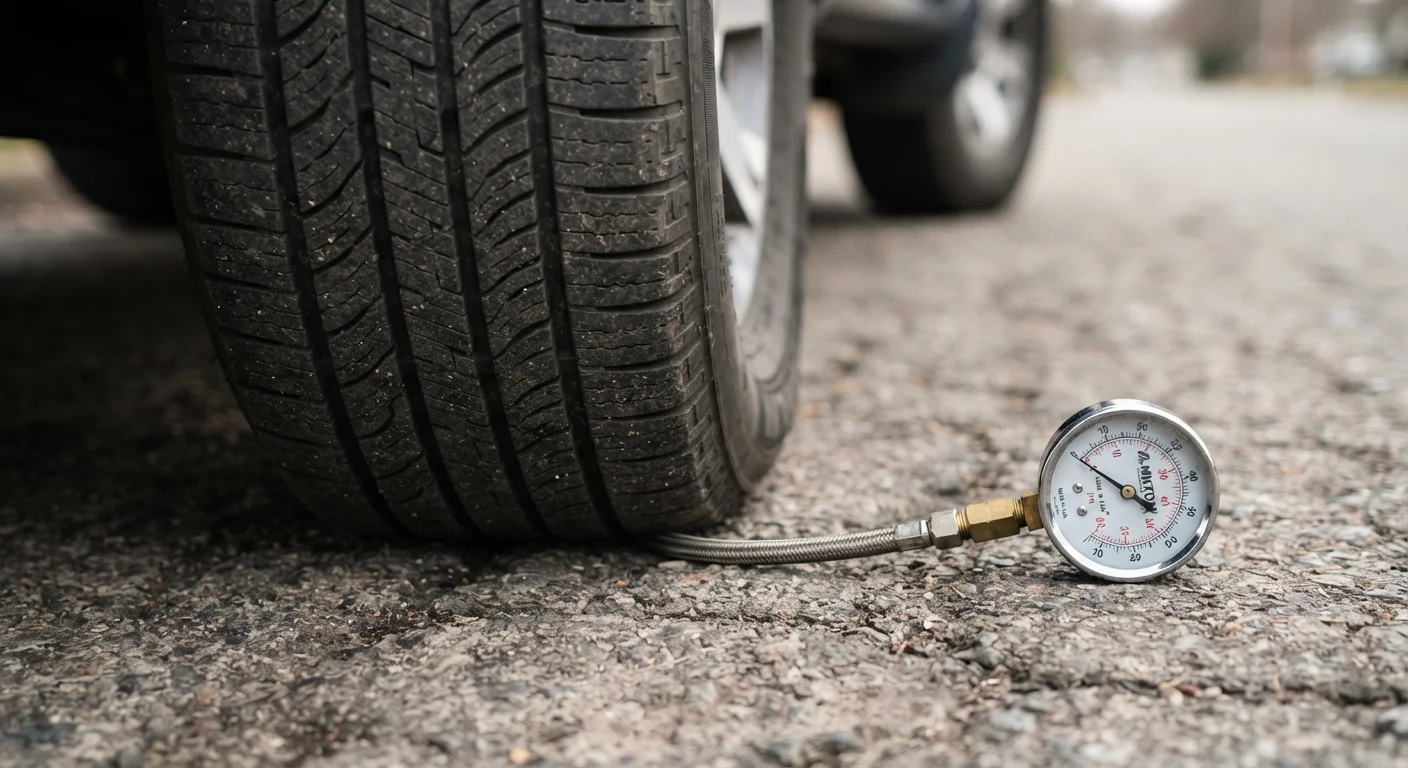
A tire can be significantly underinflated and still appear normal to the eye and hand.
Modern radial tires are designed with stiff sidewalls that don't visibly bulge until pressure is dangerously low - often 50% below the recommended level or more. Underinflation increases rolling resistance (costing fuel economy), generates excess heat in the tire carcass (accelerating wear and raising blowout risk), and reduces steering responsiveness. The only reliable way to check tire pressure is with a calibrated gauge. Digital gauges are inexpensive and more accurate than stick-type gauges. Check pressure when the tires are cold - before driving more than a mile - for an accurate reading.
Myth
The penny test is the gold standard for checking tread depth.
Fact
The penny test reveals only that tires are at or near the legal minimum - a threshold that many safety researchers consider dangerously low.
The penny test involves inserting a cent into a tread groove with Lincoln's head pointing down; if you can see the top of Lincoln's head, the tread is at or below 2/32 of an inch - the legal minimum in most U.S. states. The problem is that stopping distances increase substantially well before tires reach that minimum. Independent testing has shown that tires at 2/32" take significantly longer to stop on wet roads than tires at 4/32". A quarter, used the same way (Washington's head down), flags tires at 4/32" - a more conservative and safer benchmark. Replacing tires at 4/32" rather than waiting for the legal limit is especially important in wet or snowy climates.
Myth
New tires should always be put on the front axle.
Fact
New or better tires should go on the rear axle, regardless of whether the vehicle is front-wheel drive or rear-wheel drive.
This is one of the more counterintuitive tire facts, but the reasoning is sound: rear tire failure is significantly harder to control than front tire failure. If a rear tire loses grip on a wet road, the vehicle can oversteer and spin out - a situation that even experienced drivers struggle to recover from. Front tire issues, while serious, are generally more recoverable because the driver still has steering input. Major tire industry organizations and vehicle safety engineers consistently recommend placing the highest-tread tires on the rear axle. This applies even to front-wheel-drive vehicles, where the engine drives the front wheels.
Myth
Tire rotation is only necessary for high-mileage vehicles.
Fact
Rotation benefits every vehicle from the first service interval, typically recommended every 5,000-7,500 miles.
Tire wear is uneven by nature. Front tires carry more of the braking load and, on front-wheel-drive vehicles, also handle acceleration and steering forces. Rotating tires - moving them between axles and sometimes side to side, depending on the rotation pattern specified for your vehicle - distributes wear more evenly. This extends the usable life of the full set and helps maintain predictable handling. Most vehicle manufacturers build rotation into the same interval as oil changes, making it easy to bundle into a single service appointment. Skipping rotations early in a tire's life doesn't just shorten that tire's mileage - it can cause uneven wear that no amount of future rotation will fully correct.
What the Numbers Actually Mean for Your Tires
Tire specifications can look like a foreign language stamped on rubber - PSI ratings, tread-wear indicators, load indices. Two numbers matter most to daily drivers: the recommended inflation pressure (found on the driver's door jamb sticker or owner's manual) and remaining tread depth.
~1 PSI
Monthly pressure loss under normal conditions
Tires naturally lose approximately 1 PSI per month, and lose roughly 1 additional PSI for every 10°F drop in temperature, according to the U.S. Department of Energy.
4/32"
Recommended tread replacement threshold
Independent braking tests have shown meaningfully longer wet-road stopping distances at 2/32" versus 4/32" of remaining tread depth.
~0.5%
Fuel economy lost per 1 PSI underinflation
The U.S. Department of Energy estimates fuel economy drops by roughly 0.5% for every 1 PSI that all four tires are underinflated below the recommended level.
Staying on top of these figures is straightforward, but it requires checking them rather than assuming everything is fine. Tires lose roughly 1 PSI per month under normal conditions and about 1 PSI for every 10°F drop in ambient temperature - meaning a tire that was correct in September may be noticeably underinflated by January. Building a brief monthly check into your routine costs almost nothing and pays off in fuel economy, handling, and tire longevity. Neglecting these basics is one of the maintenance habits that shorten a car's lifespan.
Don't Mix Tire Types on the Same Axle
Mixing summer and all-season tires, or tires with significantly different tread depths, on the same axle can create handling imbalances that are difficult to predict, especially during emergency maneuvers. If you need to replace fewer than four tires, match the new tire's brand, model, and size to the existing tire on the same axle wherever possible. When in doubt, ask a qualified tire technician before mixing.