

What Makes a Fat Saturated or Unsaturated?
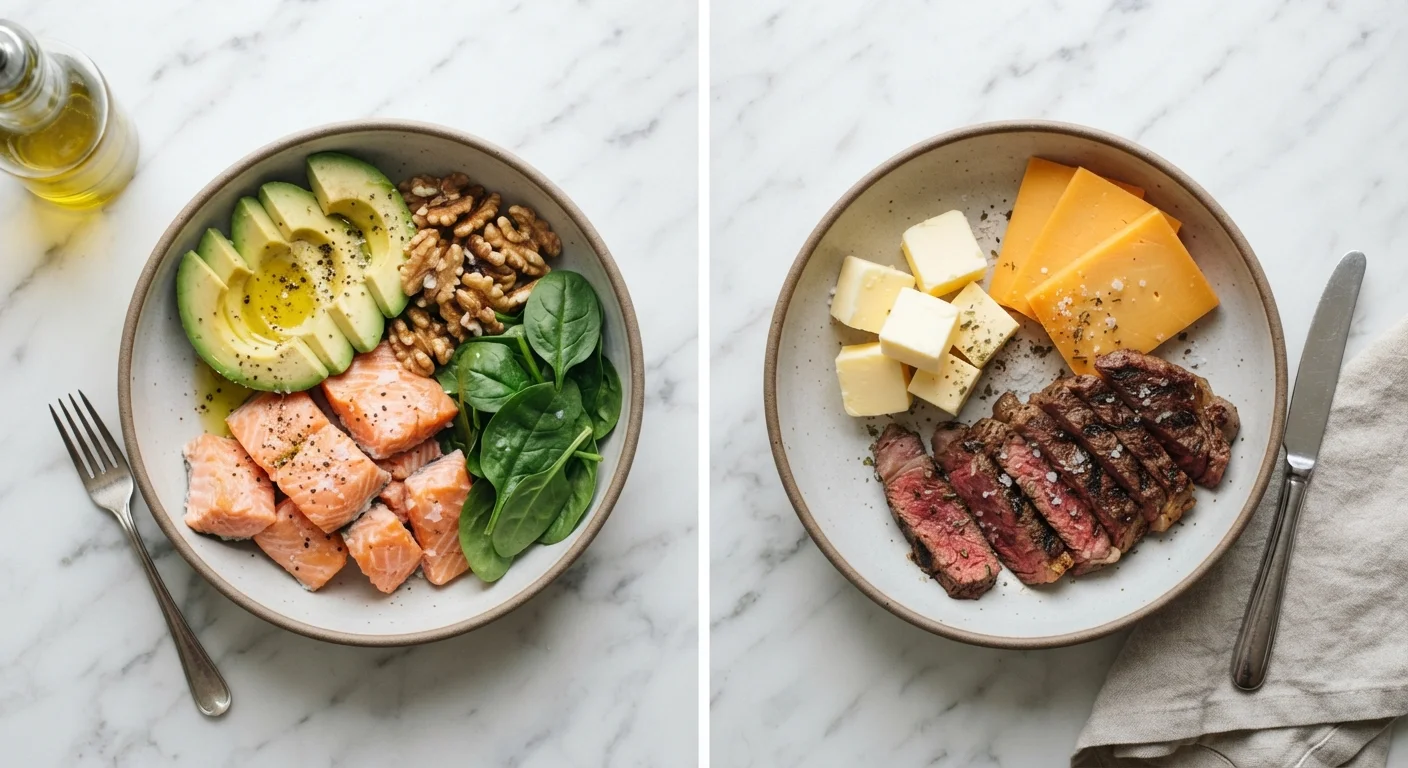
The terms refer to the chemical structure of fatty acid chains. Saturated fats have no double bonds between carbon atoms - every carbon is fully "saturated" with hydrogen. This makes them solid at room temperature. Think butter, coconut oil, lard, and the fat in full-fat dairy and red meat.
Unsaturated fats contain one or more double bonds, which introduce a kink in the chain and keep them liquid at room temperature. Monounsaturated fats (MUFAs) have one double bond - found in olive oil, avocados, and most nuts. Polyunsaturated fats (PUFAs) have two or more - found in fatty fish, walnuts, flaxseed, and vegetable oils. Omega-3 and omega-6 fatty acids are both PUFAs and are considered essential because the body cannot synthesise them.
For a broader look at how fat fits into your overall eating pattern, see our plain-language macronutrient guide.
| Criterion | Saturated Fat | Unsaturated Fat |
|---|---|---|
| Chemical structure | No double bonds; solid at room temp | One or more double bonds; liquid at room temp |
| Common food sources | Butter, red meat, full-fat dairy, coconut oil | Olive oil, avocado, fatty fish, nuts, seeds |
| Effect on LDL cholesterol | Generally raises LDL in most people | PUFAs lower LDL; MUFAs neutral to mildly positive |
| Effect on HDL cholesterol | Modestly raises HDL | MUFAs maintain or raise HDL; PUFAs vary |
| Cardiovascular research consensus | Elevated intake linked to increased risk; context dependent | Consistently associated with reduced cardiovascular risk |
| Major health body guidance | Limit to ~10% of daily calories or less | Prioritise; replace saturated fats where possible |
| Role of replacement food | Risk profile changes based on what replaces it | Greatest benefit seen replacing saturated fat |
What the Research Actually Says About Heart Health
For decades, the prevailing view was straightforward: saturated fat raises LDL (low-density lipoprotein) cholesterol, elevated LDL increases cardiovascular disease risk, so eating less saturated fat protects your heart. That chain of logic is partially - but not wholly - supported by evidence.
A substantial body of research, including long-running cohort studies and controlled feeding trials, confirms that saturated fat does raise LDL cholesterol in most people. The American Heart Association and the World Health Organization continue to recommend limiting saturated fat to roughly 10% of total daily calories or less, based on this evidence.
However, more recent meta-analyses have complicated the picture. A key insight from research published in journals such as Annals of Internal Medicine and PLOS Medicine is that the replacement nutrient matters enormously. Replacing saturated fat with refined carbohydrates confers little or no benefit. Replacing it with polyunsaturated fats appears to meaningfully reduce cardiovascular risk. This nuance is why some studies found no strong direct link between saturated fat intake and heart events - they didn't account for what people were eating instead.
~8-10%
Recommended max share of calories from saturated fat
Both the American Heart Association and the 2020-2025 US Dietary Guidelines advise limiting saturated fat to approximately 10% of total daily caloric intake.
~17%
Reduction in cardiovascular risk from PUFA swap
A landmark analysis published in PLOS Medicine estimated roughly a 17% lower cardiovascular risk when 5% of calories from saturated fat were replaced with polyunsaturated fat.
2 servings/week
Fatty fish intake associated with heart-health benefits
The American Heart Association recommends eating two servings of fatty fish per week as part of a heart-healthy dietary pattern, citing omega-3 PUFA evidence.
Unsaturated fats, by contrast, show consistent benefits. Omega-3 PUFAs reduce triglycerides and may lower inflammation markers. Olive oil consumption is associated with lower rates of cardiovascular events in Mediterranean populations. These associations hold across diverse study designs.
Source and Food Context Change the Equation
One of the most important refinements in nutrition science is recognising that foods - not isolated nutrients - are what people actually eat. Saturated fat from full-fat yogurt or unprocessed cheese behaves differently in the body than saturated fat from processed meats or packaged snack foods, partly because of the accompanying nutrients: protein, calcium, fermentation byproducts, and the food's overall matrix.
A growing body of evidence suggests that fermented dairy foods in particular may not carry the cardiovascular risk historically attributed to their saturated fat content. This doesn't mean saturated fat is risk-free, but it reinforces that food quality and overall dietary pattern matter more than any single nutrient in isolation.
Natural vs. Artificial Trans Fats
Trans fats fall into two distinct categories. Artificial trans fats (partially hydrogenated oils), once widespread in processed foods, are associated with significantly elevated cardiovascular risk and have been largely phased out in the US food supply. Natural trans fats - such as conjugated linoleic acid (CLA) found in small amounts in beef and dairy - appear to behave differently and are not associated with the same harms in current research. Reading nutrition labels can help you monitor intake; our nutrition label explainer covers what to look for.
Similarly, not all unsaturated fat sources are equivalent. Industrial seed oils high in omega-6 PUFAs consumed in large excess - without balancing omega-3 intake - may contribute to inflammation pathways, though this remains an active area of research rather than settled science.
For guidance on decoding fat information on food packaging, our nutrition labels guide walks through how to read fat grams and daily value percentages in context.
Practical Takeaways for Everyday Eating
The evidence doesn't call for fat phobia - it calls for fat selectivity. Here's what a balanced reading of the research suggests:
- Prioritise unsaturated fat sources as your primary dietary fat: olive oil, avocados, fatty fish (salmon, mackerel, sardines), walnuts, and seeds.
- Limit saturated fat rather than eliminate it entirely. Focus especially on reducing it from ultra-processed and fast-food sources, where it typically arrives alongside refined carbohydrates and sodium.
- Avoid artificial trans fats entirely - partially hydrogenated oils are the clearest dietary hazard and have been largely removed from the US food supply following regulatory action, but remain worth checking labels for.
- Look at dietary patterns overall. The Mediterranean and DASH eating patterns - both high in unsaturated fats - have the strongest consistent evidence for cardiovascular and overall health benefits. See our evidence behind popular eating patterns for a research-grounded overview.
Those with specific health conditions, elevated cholesterol, or cardiovascular risk factors should discuss dietary fat targets with a qualified healthcare provider or registered dietitian, as individual needs vary significantly.
This article is for general informational and educational purposes only and is not a substitute for professional medical or nutritional advice. Always consult a qualified healthcare provider for guidance specific to your health situation.