
What 'Added Sugar' Actually Means
Not all sugar in food is created equal. Naturally occurring sugars - like fructose in fruit or lactose in milk - come packaged with fiber, protein, vitamins, and other nutrients. Added sugars, by contrast, are any sugars or sweeteners introduced during processing or preparation. They deliver sweetness and calories but bring no nutritional co-passengers.
The U.S. Food and Drug Administration (FDA) requires that added sugars appear as a separate line item on Nutrition Facts panels - a rule that took effect for most manufacturers in 2020. That distinction matters because research consistently links high added-sugar intake to increased risk of cardiovascular disease, type 2 diabetes, and dental caries, according to the Dietary Guidelines for Americans.
For a broader walkthrough of the label itself, see our plain-language guide to nutrition labels.
| FDA added sugar line requirement | Mandatory since 2020 for most manufacturers (U.S. Food and Drug Administration) |
| Recommended daily limit (adults) | Less than 10% of total daily calories (Dietary Guidelines for Americans, 2020-2025) |
| Grams at 2,000-calorie reference diet | ~50 g / ~12 teaspoons per day (Dietary Guidelines for Americans, 2020-2025) |
| Top dietary source of added sugar | Sugar-sweetened beverages (Centers for Disease Control and Prevention (CDC)) |
| Number of names for added sugar | Over 60 recognized synonyms (American Heart Association consumer guidance) |
The Many Names for Added Sugar on Ingredient Lists
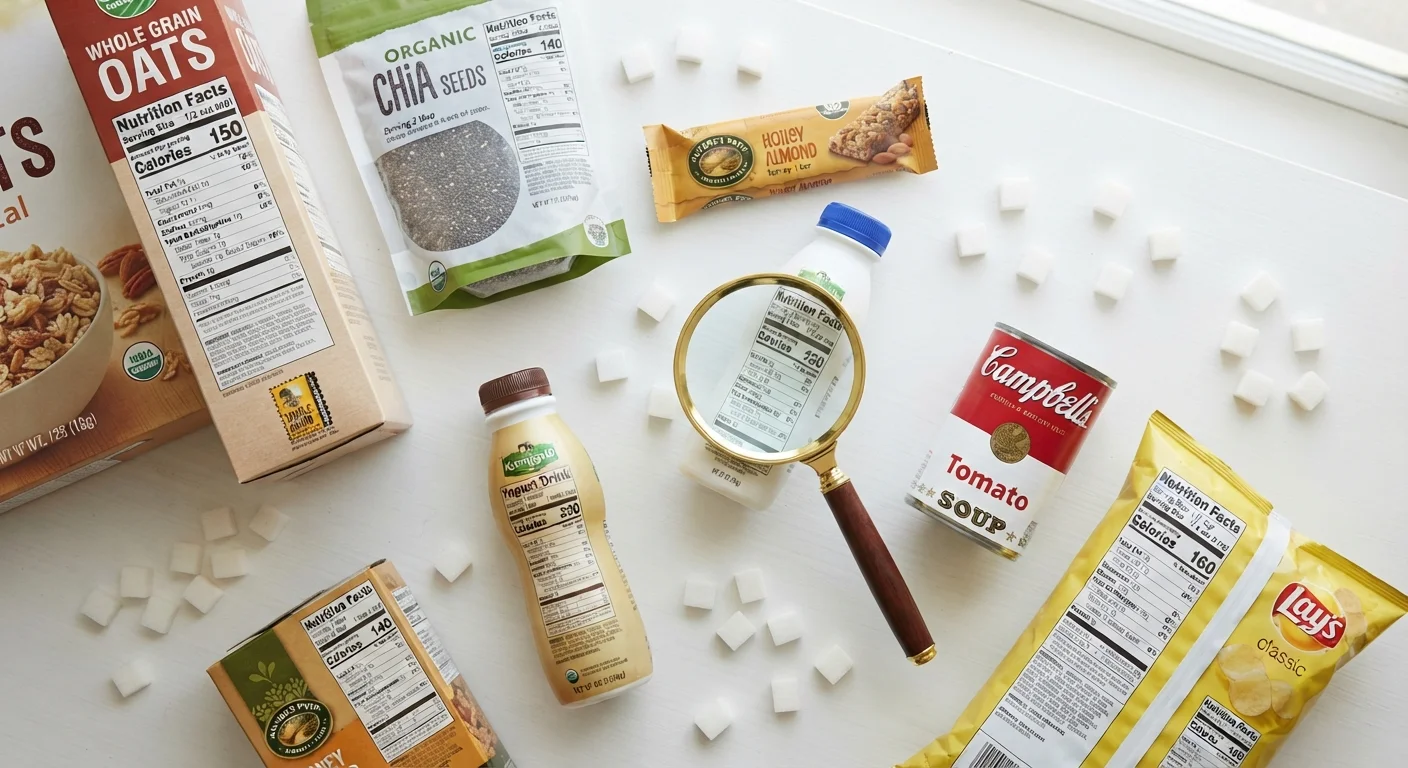
Ingredient lists are where added sugars hide most effectively. Food manufacturers use dozens of synonyms - all legitimate, all sweeteners - which can scatter the sugar load across several entries so no single one appears near the top of the list. Knowing the aliases is the first step to an accurate read.
Added sugar
Any sugar or caloric sweetener added to food or beverages during processing or preparation, distinct from sugars that occur naturally in whole ingredients like fruit or dairy.
High-fructose corn syrup (HFCS)
A liquid sweetener derived from cornstarch in which some glucose has been converted to fructose. Commonly used in sodas, baked goods, and condiments; classified as an added sugar.
Agave nectar
A sweetener extracted from the agave plant, often marketed as a natural alternative. It is high in fructose and classified as an added sugar on nutrition labels.
Maltodextrin
A carbohydrate derived from starch, used as a thickener or sweetener in processed foods. It has a high glycemic index and may contribute to total added sugar depending on its use.
Fruit juice concentrate
Fruit juice with most of its water removed, used as a sweetener in food production. When used to sweeten rather than as a whole-fruit ingredient, it is counted as added sugar.
% Daily Value (%DV)
A reference figure on U.S. nutrition labels showing how much a nutrient in one serving contributes toward a standard daily intake goal. For added sugar, 5% DV or less is considered low; 20% DV or more is considered high.
A practical rule: any ingredient ending in -ose (sucrose, dextrose, maltose, fructose) is a sugar. Words like syrup, nectar, juice concentrate, or malt are also reliable signals. When multiple sweetener synonyms appear in one ingredient list, their combined contribution can be substantial even if each sits low on the list individually.
For a deeper look at where these ingredients show up across product categories, see where added sugars hide in everyday foods.
Interpreting the Numbers on a Nutrition Label
The Nutrition Facts panel now shows added sugars in two ways: grams per serving and a % Daily Value (%DV). The %DV is based on a reference intake of 50 grams of added sugar per day for a 2,000-calorie diet. The Dietary Guidelines for Americans recommend keeping added sugar below 10% of total daily calories - roughly 50 grams at 2,000 calories, or about 12 teaspoons.
A few label-reading pitfalls to watch for:
- Serving size distortion: A beverage container listed as 2.5 servings means you multiply every number - including added sugars - by 2.5 if you drink the whole thing.
- "No added sugar" claims: This phrase means no sugar was added during processing, but the product may still contain naturally occurring sugars or high-calorie sweeteners not classified as added sugar by the FDA, such as certain fruit juice concentrates in some product categories.
- "Reduced sugar" vs. "low sugar": "Reduced" means at least 25% less than the reference product - it does not indicate an absolute amount.
Our article on decoding nutrition facts panels covers %DV calculations and serving size rules in full detail.
"Natural" Sweeteners Are Still Added Sugar
Honey, maple syrup, coconut sugar, and date syrup are frequently perceived as healthier alternatives to white sugar, but the FDA classifies all of them as added sugars on nutrition labels. Gram for gram, they contribute a similar caloric load. Their minor micronutrient content does not meaningfully offset the impact of excess intake. Use them the same way you would any other sweetener: in moderation.
Putting Your Intake in Context
Understanding where added sugar concentrates in a typical diet helps prioritize where to focus attention. Sugar-sweetened beverages - sodas, energy drinks, flavored coffees, and fruit drinks - are the single largest source of added sugars for most Americans, according to the Centers for Disease Control and Prevention (CDC). Grain-based desserts, candy, dairy desserts, and condiments follow.
Reducing added-sugar intake doesn't require eliminating entire food groups. Practical starting points include choosing plain versions of yogurt, oatmeal, or nut butters and adding your own fruit; reading labels on sauces, salad dressings, and bread - categories that surprise many shoppers; and being skeptical of health halos on products labeled "natural," "organic," or "made with real fruit," since these claims don't limit added sugar content.
For a structured approach to applying this knowledge at the grocery store, see our grocery shopping with nutrition in mind.
This article is for general informational purposes only and does not constitute medical or dietary advice. Consult a registered dietitian or qualified healthcare professional for guidance tailored to your individual health needs.