

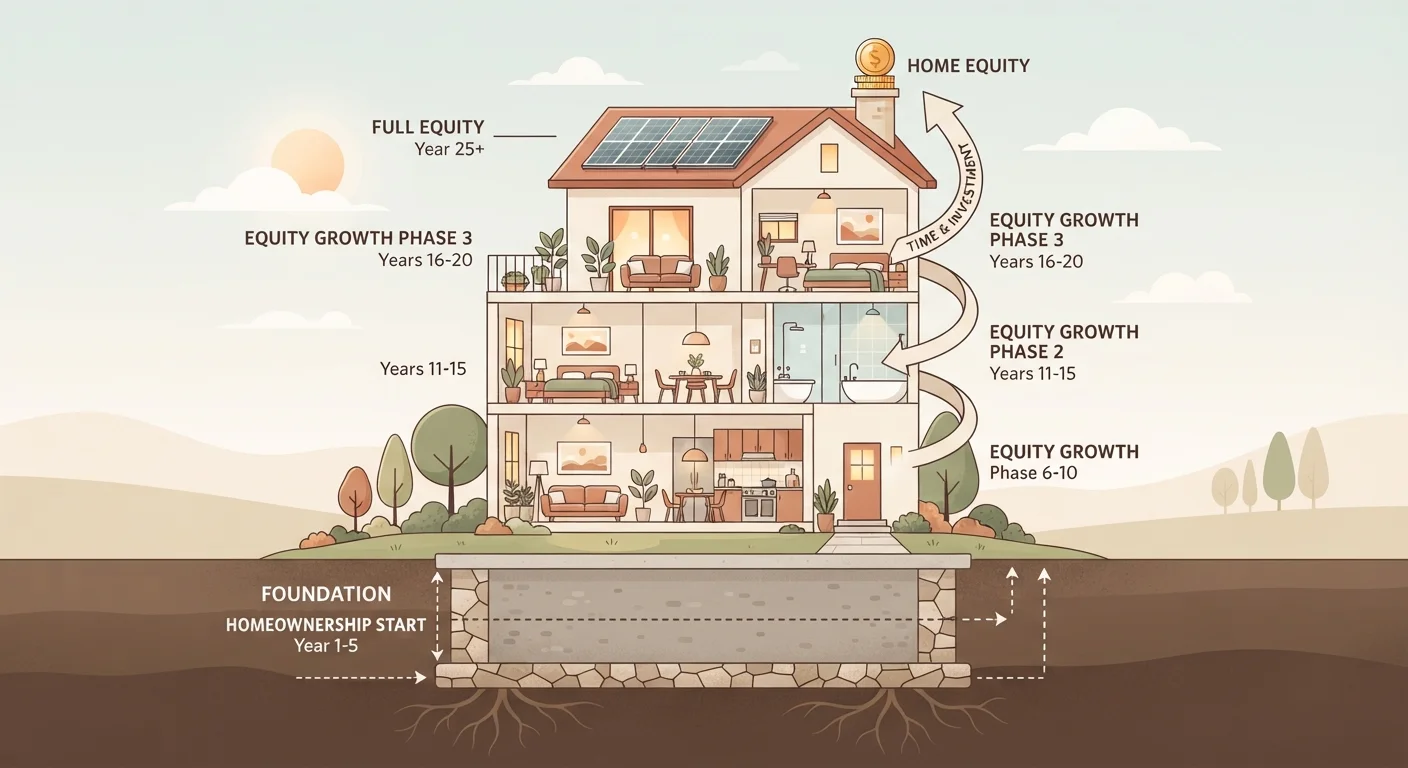
What Home Equity Actually Is
Home equity is the share of your property that you truly own - the difference between what your home is worth on the market and what you still owe on your mortgage.
Here's the simple formula:
Home Equity = Current Market Value − Outstanding Mortgage Balance
If your home is appraised at $400,000 and your remaining loan balance is $260,000, your equity is $140,000. That $140,000 represents your financial stake in the property.
It's worth noting that market value isn't a fixed number - it's an estimate of what buyers would pay today, which fluctuates with local conditions and broader economic forces. For context on how debt types like mortgages are structured, see our explainer on secured versus unsecured debt.
Home Equity
The portion of your home's value you own outright - calculated as market value minus your remaining mortgage balance.
Market Value
The estimated price a buyer would pay for your home in current market conditions. It changes over time and is not the same as the purchase price.
Amortization
The schedule by which your mortgage payments are divided between interest and principal. Early payments go mostly to interest; later payments put more toward the principal.
HELOC
A Home Equity Line of Credit - a revolving credit line using your home as collateral, letting you borrow up to a set limit and repay as you go.
Cash-Out Refinance
Replacing your existing mortgage with a larger new one, receiving the difference between the two amounts as a lump sum of cash.
Underwater
A situation where a homeowner owes more on their mortgage than the current market value of the home - also called being "upside down" on the loan.
How Equity Builds Over Time
Equity grows through two main forces, and both can work simultaneously.
1. Mortgage Payments
Every monthly payment chips away at your principal balance - though early payments are weighted heavily toward interest due to how amortization works. Over the years, the principal portion grows, and your equity rises accordingly. Making extra principal payments is one reliable way to speed this up.
2. Property Value Appreciation
When your home's market value rises - due to neighborhood improvements, local demand, or broader market trends - your equity increases even if your loan balance stays the same. A $30,000 increase in market value translates directly into $30,000 more equity, all else being equal.
Your initial down payment also matters: a 20% down payment means you start with 20% equity on day one, giving you a stronger foundation from the outset.
Small Extra Payments, Big Equity Impact
Even modest additional principal payments - say, rounding up to the next hundred dollars each month - can shave years off a mortgage and meaningfully grow your equity. If your lender allows it, designating extra payments specifically toward principal ensures they reduce your balance directly rather than being applied to future interest.
What Can Make Equity Shrink
Equity isn't guaranteed to grow - several factors can reduce it.
- Falling property values: If local market conditions soften or a broader downturn hits, your home may be worth less than it was. Your equity shrinks even if your loan balance is unchanged.
- Borrowing against the home: Taking out a home equity loan, HELOC, or cash-out refinance increases your total debt, which directly lowers your equity stake.
- Slow early repayment: In the early years of a mortgage, most of your payment covers interest rather than principal, so equity from payments builds gradually.
In extreme cases - particularly if values drop sharply after a small down payment - a homeowner can end up "underwater," meaning the loan balance exceeds the home's current value. This limits refinancing options and can complicate selling.
Going Underwater Is a Real Risk
If you purchased with a small down payment and local values drop, you could find yourself owing more than your home is worth. This situation limits your ability to refinance or sell without a loss. Building equity steadily and avoiding over-leveraging helps protect against this outcome.
Ways Homeowners Tap Into Equity
Equity isn't just a number on paper - it can be converted into usable funds through several financial products. Each carries different structures and risks.
Home Equity Loan
A lump-sum loan secured by your home, typically at a fixed interest rate. You repay it in regular installments over a set term, separate from your primary mortgage.
Home Equity Line of Credit (HELOC)
A revolving credit line - similar in structure to a credit card - backed by your home equity. You borrow as needed during a draw period, then repay during a repayment period. Interest rates are often variable.
Cash-Out Refinance
You replace your existing mortgage with a new, larger loan and receive the difference in cash. This restarts your mortgage term and changes your interest rate, which may be higher or lower depending on current market conditions.
Homeowners sometimes use these funds for home improvements - for practical guidance on planning those projects, see getting started with home improvement. Others use equity to consolidate high-interest debt, though that approach has meaningful trade-offs explored in debt consolidation: what it solves and what it doesn't.
Consumer Financial Protection Bureau (CFPB) - Home Equity Resources
The CFPB publishes plain-language guides on HELOCs and home equity loans, including key questions to ask lenders and your rights as a borrower.
Mortgage Amortization Calculator
An amortization calculator lets you visualize exactly how much of each payment goes to principal versus interest over the life of your loan, and how extra payments affect your equity.
Is Accessing Your Equity a Good Idea?
Equity access can serve legitimate financial needs, but the decision deserves careful thought - not impulse. Because your home secures any loan taken against it, defaulting puts your property at risk of foreclosure. That's a consequence far more serious than missing a credit card payment.
Questions worth asking before tapping equity:
- Will the funds be used for something that preserves or increases value - like a structural repair or addition - or for discretionary spending?
- Can you comfortably afford the new monthly payments alongside your existing obligations?
- How does the interest rate compare to other borrowing options available to you?
Understanding the terms attached to any equity product matters too - if you're unfamiliar with loan terminology, the credit glossary covers key concepts clearly. And if you'd like to understand how interest compounds on borrowed balances over time, compound interest explained is a useful companion read.
Ultimately, equity is one of the most valuable financial assets a homeowner holds. Treating it with care - growing it intentionally and accessing it only with a clear purpose - is generally the soundest approach.
This article is for general informational and educational purposes only and does not constitute financial or legal advice. Consult a qualified financial professional before making decisions about borrowing against your home equity.
Equity Access Is Not Free Money
It's easy to think of home equity as a savings account you can dip into freely - but every dollar accessed becomes a loan that must be repaid, with interest, and secured by your home. The psychological distance between equity and debt can cause homeowners to underestimate the real cost of borrowing against their property.