
How Each Channel Works
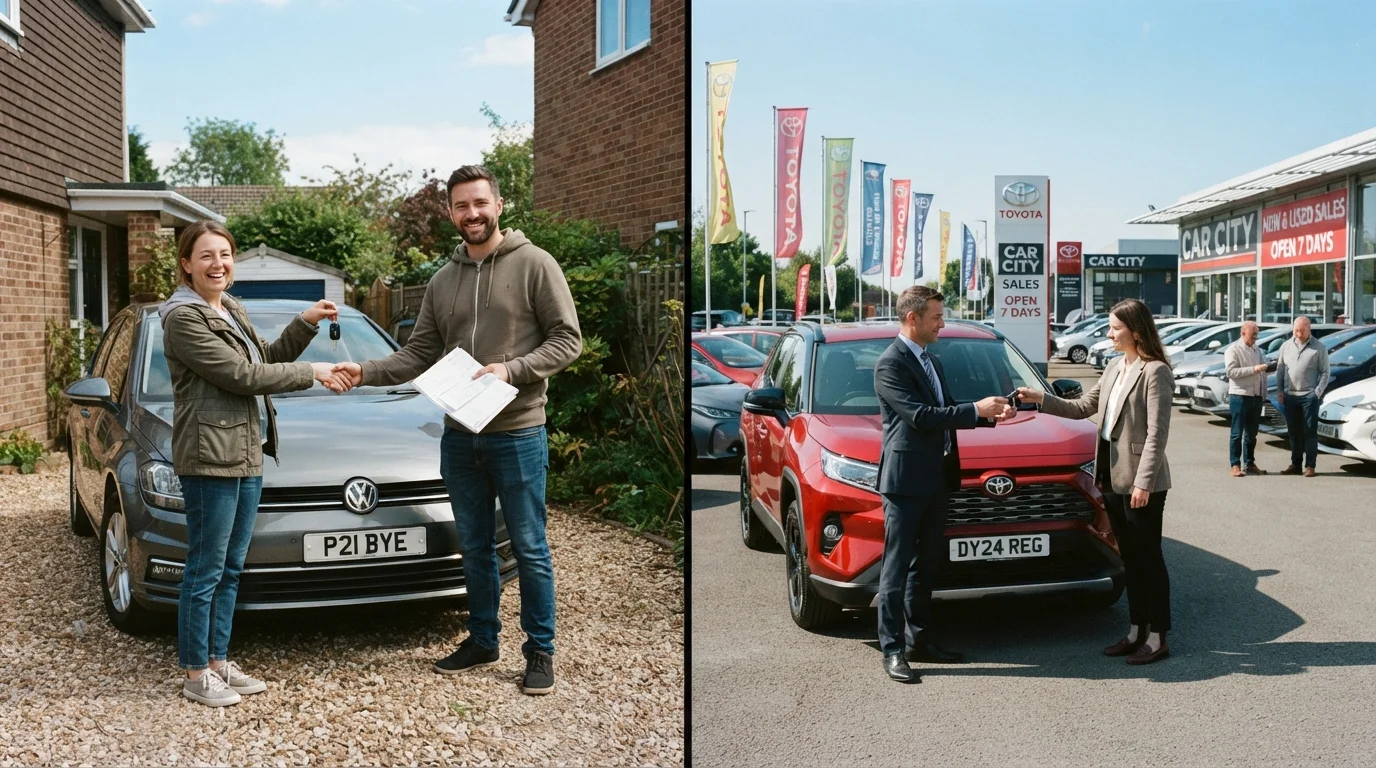
When you buy from a private seller, you're dealing directly with an individual - typically through a classified listing - and the transaction is usually cash or a cashier's check. There's no middleman, no finance office, and no service department. The paperwork is minimal: a signed title and a bill of sale.
A dealership, by contrast, is a licensed business regulated by state motor vehicle laws and, for used cars, the Federal Trade Commission's Used Car Rule. That rule requires dealers to display a Buyers Guide disclosing whether the vehicle is sold as-is or with a warranty. Dealers also handle title transfers in-house and can facilitate financing on the spot. For a full picture of what the buying journey looks like from either starting point, see The Car-Buying Process, Start to Finish.
Advantages and Disadvantages
Both routes have genuine upsides - and genuine pitfalls. Weigh these carefully against your own situation before committing.
Lower purchase price on average
Private sellers don't carry dealership overhead, so asking prices are often several hundred to a few thousand dollars below comparable dealer listings for the same vehicle.
Less high-pressure sales environment
There's no finance office pushing add-ons, no commissioned salesperson, and no structured negotiation process - the conversation is typically more straightforward.
Dealerships provide legal consumer protections
Licensed dealers must comply with the FTC Used Car Rule and applicable state lemon laws, giving buyers meaningful recourse that private sales do not offer.
Dealerships offer on-site financing
Buyers who haven't arranged a loan in advance can finance directly through the dealer, which streamlines the transaction - though comparing rates independently is advisable.
Certified pre-owned options available at dealerships
CPO programs include manufacturer-backed inspections and extended warranty coverage - protections that are impossible to replicate in a private sale. See what a CPO label actually guarantees before assuming full coverage.
Private sales involve minimal paperwork
The transaction is typically a signed title and a bill of sale - no multi-page dealer contract, no add-on disclosures, and no trip to a finance office.
Private sales are almost always as-is
Once money changes hands with a private seller, the buyer has very limited legal recourse if a mechanical problem emerges - even one the seller knew about.
Private buyers must arrange financing independently
Without a pre-approved auto loan from a bank or credit union, a private purchase may not be feasible, which adds a step before you can even make an offer.
Dealership fees add to the purchase price
Documentation fees, dealer prep charges, and other line items can add hundreds to the out-of-pocket cost beyond the negotiated vehicle price.
Private sellers may not disclose all defects
Disclosure obligations for private sellers vary by state and are generally less stringent than dealer requirements, making due diligence more critical.
Dealership negotiations can feel one-sided
Salespeople negotiate car deals every day; most buyers do not. Understanding what's actually negotiable helps - see Negotiating at a Dealership Without Feeling Outmatched.
The Price vs. Protection Trade-Off
The central tension is straightforward: private sellers set prices without the overhead a dealership carries - no lot fees, no reconditioning costs, no commissioned salespeople. That can translate to a meaningfully lower asking price. But "lower price" doesn't always mean "better deal" if the car hides a costly mechanical problem.
~$2,000
Typical private-sale price discount vs. dealer
Industry observers and automotive pricing analysts generally estimate private-party transaction prices run meaningfully below dealer retail, though the gap varies by vehicle age, condition, and market.
1 in 5
Used cars with undisclosed prior damage
Vehicle history data providers have reported that a significant share of used vehicles on the market carry accident or damage history not immediately visible to buyers.
Dealerships are legally required to disclose known defects on the Buyers Guide. Private sellers in most states have a narrower duty to disclose, and proving a seller knew about a defect after the fact is difficult and expensive. An as-is sale with a private party means exactly that.
Financing is another practical gap. Banks and credit unions will generally not finance a private-party purchase at the dealership counter - you'll need a pre-approved personal auto loan or the cash in hand before you make an offer. Dealers, meanwhile, have relationships with multiple lenders and can arrange financing during the transaction, though it pays to compare those offers; see Financing Through a Dealer vs. Your Own Bank for a detailed comparison.
Title Transfer: Know Your State's Rules
In a private sale, you are responsible for ensuring the title is clean, properly signed over, and submitted to your state's DMV within the required timeframe. Delays or errors can result in fines or registration problems. Dealerships handle this process for you as part of the transaction, which removes a layer of administrative risk. Always verify your state's specific title transfer requirements before finalizing a private purchase.
Protecting Yourself Whichever Route You Choose
Regardless of where you buy, a pre-purchase inspection (PPI) by an independent mechanic is one of the highest-value steps a used-car buyer can take. A reputable seller - private or dealer - should not refuse a reasonable request for an inspection. If they do, treat that as a red flag.
Run a vehicle history report using the VIN to check for reported accidents, title issues, odometer discrepancies, and prior ownership. This doesn't catch everything, but it catches a lot. At a dealership, also review the Buyers Guide closely: note whether any warranty is offered and exactly what it covers. Be cautious of dealer add-ons bundled into the deal - Dealer Add-Ons That Are Often Not Worth the Cost explains which extras are commonly oversold. If you want to understand what the sticker price actually means for your negotiating room, Sticker Price, Invoice Price, and What You Actually Pay is worth reading before you sit down at the desk.