
The Core Safety Difference: Conflict Points
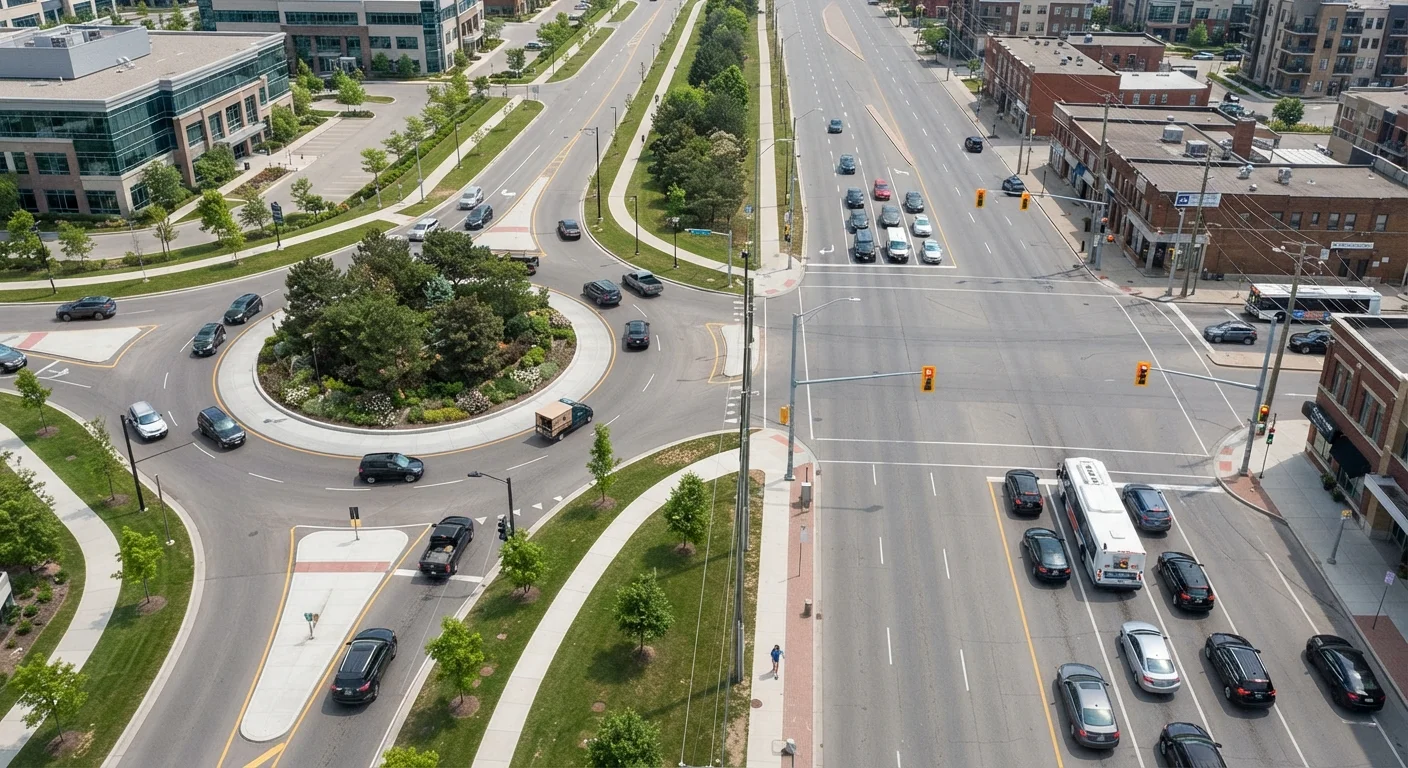
Every intersection creates conflict points - locations where vehicle paths cross, merge, or diverge. A standard four-way signalized intersection generates up to 32 vehicle-to-vehicle conflict points. A single-lane roundabout cuts that number to 8, and eliminates the most dangerous types entirely.
The crashes that kill people at traditional intersections tend to be angle crashes (T-bones) and head-on collisions - both of which involve high closing speeds and direct impact forces. Roundabouts replace these with lower-speed, glancing-angle or sideswipe scenarios. The Federal Highway Administration (FHWA) has documented that converting a signalized intersection to a roundabout can reduce fatal and serious-injury crashes by roughly 70-80%, and overall crashes by around 35-40%.
That's not a marginal improvement. It reflects a structural difference in how the two designs manage vehicle conflict. For more context on how intersection rules govern driver behavior, see right-of-way rules at different intersection types.
| Criterion | Roundabouts | Traditional Intersections |
|---|---|---|
| Fatal crash reduction | ~70-80% lower (vs. signals) | Baseline reference point |
| Vehicle conflict points | 8 (single-lane) | Up to 32 (four-way) |
| Typical travel speed through | 15-25 mph | Up to posted limit |
| T-bone/head-on crash risk | Eliminated by design | Present, especially on yellow/red |
| Pedestrian crossing clarity | Varies with design quality | High (dedicated signal phases) |
| Traffic flow during off-peak | Continuous, no unnecessary stops | Red-light delays regardless of volume |
| Driver familiarity (US) | Lower - learning curve exists | High - universally understood |
Why Drivers Push Back - and What the Data Actually Shows
Public opposition to roundabouts is well documented and usually centers on two concerns: confusion about yield rules and anxiety about navigating the circular lane. These are real usability issues, especially during the adjustment period after a new roundabout opens. Studies show crash rates can temporarily rise in the first months as local drivers learn the geometry.
However, that learning curve levels off, and long-term crash outcomes consistently favor the roundabout. Driver discomfort is a legitimate implementation challenge - it is not evidence that the design is unsafe. Most resistance comes from unfamiliarity, not from crash data.
One underappreciated factor: roundabouts keep traffic moving at low speeds (typically 15-25 mph inside the circle), which matters enormously for crash survivability. The probability of a pedestrian fatality drops sharply at speeds below 30 mph. At signalized intersections, vehicles often accelerate hard after a green light or run late yellows - a separate but related problem covered in our article on how drivers misjudge yellow lights.
~78%
Reduction in fatal crashes at converted intersections
The FHWA cites studies showing roundabout conversions reduce fatal crashes by approximately 78% compared to signalized intersections.
8 vs. 32
Vehicle conflict points: roundabout vs. four-way intersection
Fewer conflict points means fewer opportunities for high-speed perpendicular collisions, which are responsible for the most severe injuries.
~35%
Reduction in overall crash frequency
Beyond fatal crashes, roundabouts reduce total crash volume by roughly 35-40%, according to FHWA research summaries.
Pedestrian and Cyclist Safety: A More Nuanced Picture
Roundabouts are not a universal pedestrian win. Well-designed roundabouts incorporate raised crosswalks, splitter islands that break crossings into shorter segments, and clear sight lines - all of which reduce pedestrian crash risk. But poorly designed roundabouts, or those placed in high-pedestrian-traffic urban environments without adequate infrastructure, can increase confusion and risk for people on foot.
Cyclists face a similar complexity. Cyclists who ride in the travel lane through a roundabout are exposed to merging vehicle conflict. Some designs separate cyclists onto a dedicated path around the outside. Neither approach is perfect; local context matters significantly.
At signalized intersections, dedicated pedestrian phases and countdown timers give predictable crossing windows, which many pedestrians - particularly older adults and those with disabilities - find easier to navigate. This is a genuine tradeoff, not a design flaw on either side. Night-time visibility compounds these issues; night driving hazards affect both intersection types, but low-lit roundabouts require particular attention to lane markings and signage.
This article presents general road safety information for educational purposes. Specific infrastructure decisions involve engineering assessments that go beyond general guidance.