
Why Right-of-Way Rules Matter
Right-of-way rules don't grant legal permission to proceed - they assign the obligation to yield. That distinction matters. A driver who legally has the right of way can still be held responsible if they proceed when it's clearly unsafe. Understanding these rules helps you anticipate what other drivers are expected to do, not just assert your own position.
Intersections account for a disproportionate share of traffic crashes in the US. The Federal Highway Administration has documented that a significant percentage of serious crashes occur at or near intersections, making right-of-way one of the most consequential skills a driver can master. If you're also managing high-speed decisions on divided roads, see how highway merging technique applies similar yielding logic.
| Primary rule at uncontrolled intersections | Yield to the vehicle on your right (Uniform Vehicle Code, standard US traffic law) |
| Four-way stop tie-breaker | Right-side priority; first arrived, first to go |
| Roundabout yielding rule | Yield to vehicles already circulating inside |
| Pedestrian right of way | Applies at marked and unmarked crosswalks in most US states (State traffic laws vary; verify your state's code) |
| Flashing red light | Treat as a stop sign - full stop required |
| Left turn on green ball | Must yield to oncoming traffic and pedestrians |
Intersection Types and Their Rules
Signalized Intersections
Traffic signals control right-of-way directly. On a green light, you may proceed - but you must still yield to pedestrians in crosswalks and to vehicles already lawfully in the intersection. A left-turning driver on green must yield to oncoming traffic and pedestrians. Note that a green light does not guarantee the intersection is clear.
Four-Way Stops
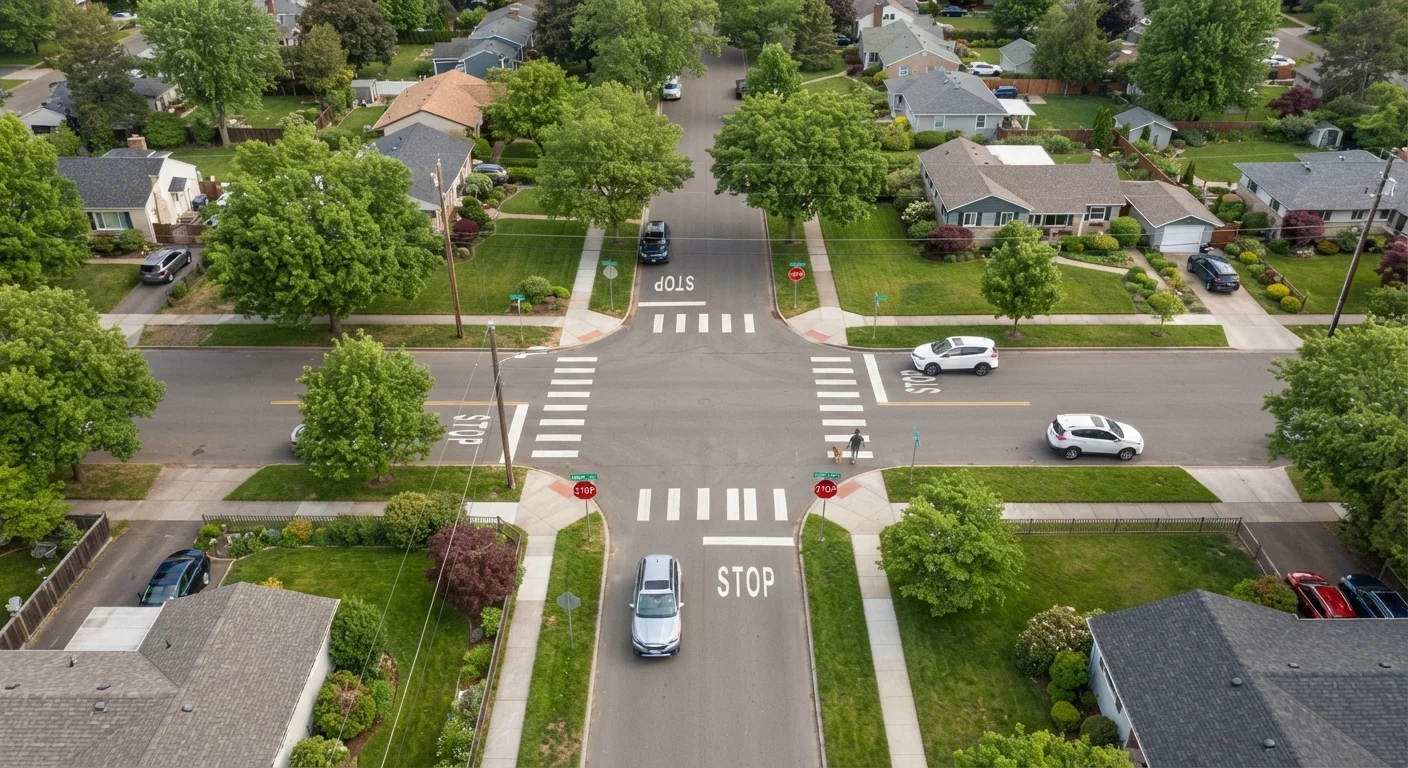
The first driver to stop is the first to go. When two vehicles stop simultaneously, the driver on the left yields to the driver on the right. When three or four vehicles arrive at the same time, the same right-side-priority rule applies - work through it one vehicle at a time. Straight-through traffic does not automatically take precedence over turning traffic at a four-way stop; arrival order does.
Two-Way Stops
Only the cross-street has stop signs. Drivers on the through road (with no sign) have right of way. Stopped drivers must wait for a safe gap before entering - this is not the same as a four-way stop.
Uncontrolled Intersections
No signs, no signals. Yield to the vehicle on your right. If you're arriving on a road that intersects with a larger or more-traveled road, treat it as a yield situation even if no sign is posted.
T-Intersections
The vehicle on the terminating road (the stem of the T) must yield to traffic on the through road. This rule applies whether or not a stop or yield sign is present.
Roundabouts
Vehicles inside the roundabout have the right of way. Entering drivers must yield to circulating traffic, then merge into the flow. For a deeper look at how roundabouts compare on safety outcomes, see roundabouts vs. traditional intersections.
Right of Way
The legal obligation of one driver to yield to another. Having the right of way means other drivers are expected to yield to you - it does not mean you can proceed regardless of conditions.
Yield
To slow or stop and allow another vehicle or pedestrian to proceed before you enter a lane or intersection. A yield sign does not always require a full stop.
Uncontrolled Intersection
An intersection with no traffic signals, stop signs, or yield signs. Drivers must rely on the right-side-priority rule to determine who proceeds first.
Green Arrow
A protected turn signal indicating the turning driver has the right of way over oncoming traffic. Different from a green ball, which requires yielding to oncoming vehicles.
T-Intersection
An intersection where one road ends and meets a through road perpendicularly. The driver on the terminating road must yield to traffic on the through road.
Common Right-of-Way Mistakes
Even experienced drivers regularly make these errors:
- Waving others through: Well-intentioned, but it can confuse drivers and create liability. Follow the rules; don't improvise traffic control.
- Assuming yield means stop: A yield sign means slow and check - stop only if traffic requires it.
- Misjudging left turns at signals: Left-turners on a green ball (not a green arrow) must yield to all oncoming vehicles. This is the source of many intersection crashes. See also how yellow light misjudgment compounds this risk.
- Ignoring pedestrian right of way: In most US states, pedestrians in a marked or unmarked crosswalk at an intersection have the right of way over turning vehicles.
- Treating a flashing red like a green: A flashing red functions as a stop sign - come to a full stop, then yield before proceeding.
State Laws Can Vary
While most US states follow the Uniform Vehicle Code as a baseline, specific right-of-way rules - particularly around pedestrians, cyclists, and emergency vehicles - can differ by state and municipality. Always verify the traffic laws in your state through your state's DMV or department of transportation. This article provides general educational guidance, not legal advice.