
Two Forces Working Against You
Every time you press the brake pedal, two separate forces are racing against the laws of physics. The first is reaction distance - the distance your car continues to travel while your brain registers a hazard and your foot moves to the brake. The second is braking distance - the distance covered from the moment brakes engage until the vehicle halts.
Reaction time for an alert driver averages around 1.5 seconds. At 30 mph, that's roughly 66 feet of travel before any deceleration begins. At 60 mph, it's approximately 132 feet - nearly half a football field - before the brakes even start working. Add in the braking distance itself, and total stopping distances become significant quickly.
Factor In Reaction Time Before Braking
Many drivers mentally calculate stopping distance starting from the moment they brake - but the distance traveled during reaction time is just as real. At 60 mph, you may cover the length of a 12-story building before your foot even touches the pedal. Build that buffer into your following distance, not just your braking estimate.
The takeaway is straightforward: the faster you drive, the longer the gap between danger and the ability to respond. Speed doesn't just shorten your reaction window; it widens the margin for error.
Why Speed Multiplies Risk Exponentially
The critical concept most drivers don't intuitively grasp is that braking distance scales with the square of speed, not linearly. This relationship comes directly from the physics of kinetic energy: KE = ½mv². When speed doubles, kinetic energy - and therefore braking distance - quadruples.
4×
Braking distance increase when speed doubles
Kinetic energy scales with the square of velocity, meaning doubling speed quadruples the energy that brakes must overcome.
~132 ft
Distance traveled during reaction time at 60 mph
At an average 1.5-second reaction time, a vehicle moving at 60 mph covers approximately 132 feet before braking begins.
50%+
Increase in stopping distance on wet pavement
Wet road surfaces significantly reduce tire friction, commonly extending stopping distances by 50% or more compared to dry conditions.
What does this mean in practice? A car traveling at 20 mph might stop in around 40 feet total. At 40 mph, the stopping distance isn't 80 feet - it's closer to 120 feet. At 60 mph, it can exceed 240 feet under good conditions. Each speed increment punishes more than the last.
This is why highway speeds leave so little margin. A driver going 70 mph on an interstate may be covering over 100 feet per second. Any distraction, hesitation, or adverse condition reduces the buffer further.
How Road Conditions Compound the Problem
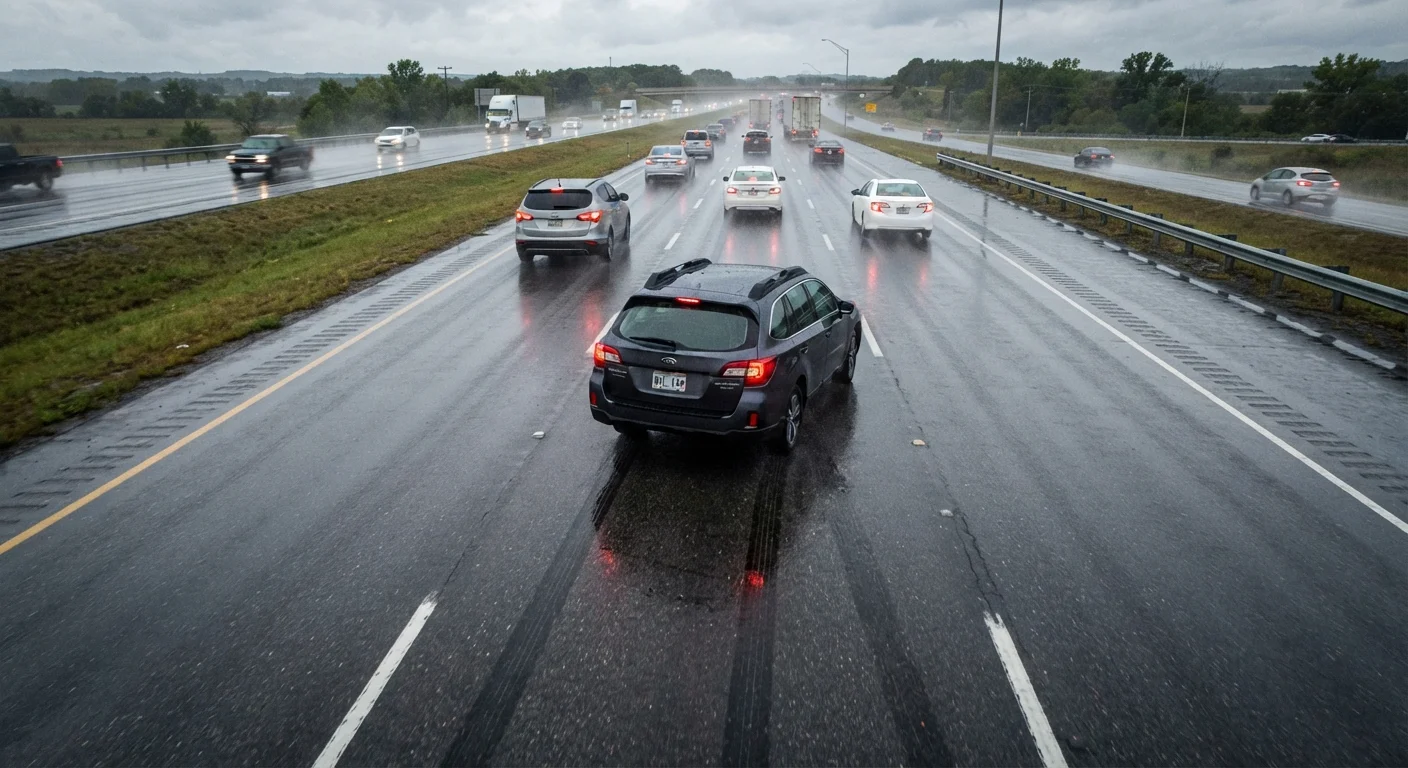
Physics on dry pavement is challenging enough. Add rain, ice, snow, or worn road surfaces, and stopping distances escalate to levels many drivers have never experienced firsthand. Tire friction - technically called the coefficient of friction - drops sharply when surfaces are compromised.
On wet roads, stopping distance commonly increases by 50% or more. On packed snow, it can double or triple. On black ice, braking distance can increase by four to ten times relative to dry pavement, depending on temperature, tire compound, and whether the vehicle has anti-lock braking (ABS). The guide to driving on rain, ice, and snow breaks down how braking behavior shifts across each surface type.
Tire condition plays a key role too. Worn tread reduces the tire's ability to channel water away from the contact patch, dramatically increasing the risk of hydroplaning - a state where the tire rides on a film of water and loses braking grip almost entirely.
ABS Helps, But Doesn't Eliminate Physics
Anti-lock braking systems prevent wheel lockup, allowing the driver to steer while braking - an important safety benefit. However, ABS does not shorten stopping distance on all surfaces. On loose gravel or deep snow, ABS can actually increase stopping distance compared to controlled wheel lockup. Understanding your vehicle's braking system and its limits is an important part of driving safely in varied conditions.
Translating Physics Into Safer Habits
Understanding the science isn't just academic - it changes how you should approach everyday driving decisions. The most effective countermeasure is simple: increase your following distance. More space means more time to react and more room to brake. This is especially important at night, when perception hazards extend your effective reaction time - a risk covered in more depth in our article on night driving hazards.
Speed management is equally important. Reducing speed by even 10 mph on a wet highway can meaningfully reduce your stopping distance. And while the two-second rule is a familiar guideline, it's a minimum - not a safety guarantee. Our article on why the two-second rule isn't always enough explains when more distance is warranted.
The science of stopping distance won't change. But how much of it works in your favor is determined by the choices you make before you ever need to brake.