

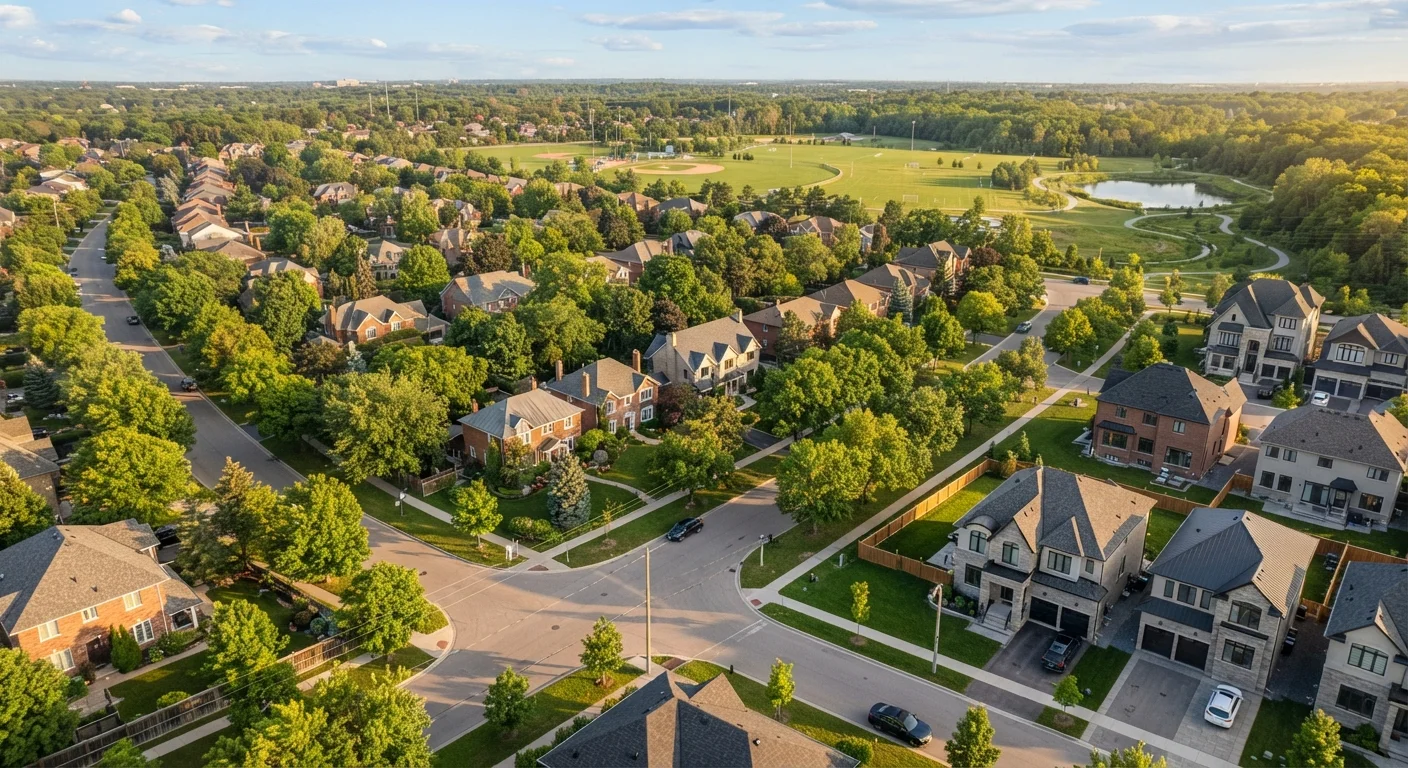
Why Location Is Really About Context, Not Just Coordinates
The real estate maxim "location, location, location" is often repeated but rarely unpacked. What it actually means is that a home's value is deeply entangled with the conditions of its surrounding neighborhood - not just its GPS coordinates. Two structurally identical houses can carry vastly different price tags depending on which side of a school district boundary they sit on, or whether the commercial corridor nearby is thriving or vacant.
For homeowners and prospective buyers, understanding these neighborhood-level dynamics is as important as evaluating the property itself. Researching a neighborhood thoroughly before committing is one of the most consequential steps in any home purchase.
~$13,000
Average home price premium per top-rated school
Research by the National Bureau of Economic Research has found that homes near higher-performing public schools command meaningful price premiums, with some studies estimating thousands of dollars per point of test score improvement.
10-20%
Typical price premium in top school districts
Industry analyses and academic studies consistently find that homes within high-rated school district boundaries sell for roughly 10% to 20% more than comparable homes outside those boundaries.
Up to 25%
Potential value uplift near new transit stations
Studies from various US metro areas have found residential properties near newly opened transit stations can appreciate by up to 25% relative to comparable properties farther from stations, though results vary by city and corridor.
School Districts: The Most Widely Documented Value Driver
Among all neighborhood factors, school district quality has generated the most consistent and well-documented relationship with home prices. Homes within the boundaries of high-rated public school districts routinely attract stronger buyer demand and command price premiums over comparable homes in lower-rated districts - even when the properties themselves are nearly identical.
This premium persists in part because school assignment in the US is largely address-based, making the home itself the access point. Buyers who may not even have school-age children frequently consider ratings, knowing they affect the pool of future buyers and therefore resale value. Licensed appraisers formally account for school districts in their valuation methodology.
Look Beyond Current Ratings
School ratings can change over time due to funding shifts, administrative changes, or demographic transitions. When evaluating a home, consider tracking a district's rating trend over several years rather than relying solely on a current snapshot. Local school board meeting minutes and state education department data are useful public resources for this research.
Public Investment, Infrastructure, and Economic Signals
When a city or county announces significant public investment in a neighborhood - a new transit line, a revitalized park system, improved road infrastructure, or a flagship library branch - nearby property values often begin to respond before construction is even complete. The anticipation of improved amenities and connectivity gets priced in by buyers who recognize long-term upside.
Similarly, the arrival of a major employer or an anchor business district can catalyze residential demand in surrounding blocks. Conversely, the closure of a major employer, a hospital, or a school can suppress values for years. These economic signals function as leading indicators that informed buyers and the broader property market take seriously.
Demographic Shifts and Their Price Ripple Effects
Neighborhoods are not static. Population movement, income shifts, and changing household compositions all leave marks on local property values over time. Gentrification - in which rising investment and higher-income residents reshape a historically lower-income area - tends to produce significant appreciation for existing owners, though it also brings complex social consequences including displacement of long-term residents.
Population decline works in the opposite direction. When residents leave faster than new ones arrive, demand for housing falls, vacancy rates climb, and values follow. This pattern is most acute in metros experiencing sustained job losses or outmigration. Understanding which direction a neighborhood is moving - and why - is essential context for anyone evaluating a home's long-term value trajectory. For a closer look at value gaps that emerge even within the same block, see why two homes on the same street can sell for very different prices.
“Neighborhood conditions are not merely background context - they are a core input in how markets price individual properties. A home does not exist in isolation from the block, the district, or the broader economic forces shaping the area around it.”
— Real Estate Editorial Team, Editorial analysis based on appraisal methodology and market research
Safety, Services, and the Cost of Neighborhood Decline
Crime rates and the quality of local public services - trash collection, road maintenance, lighting, emergency response times - are factors buyers weigh explicitly or intuitively. Neighborhoods where these services deteriorate, or where crime trends are moving in the wrong direction, tend to see dampened buyer demand regardless of individual property conditions.
A well-maintained home in a declining area may still appraise below the owner's expectations. This is one reason a home's value can drop even in a strong broader market - hyperlocal conditions override macro tailwinds. Homeowners who keep only their own property in mind, while ignoring neighborhood signals, may be caught off guard at appraisal time.
This article is for general informational and educational purposes only and does not constitute financial, legal, or real estate advice. Consult a licensed real estate professional for guidance specific to your situation.