
Location Is Just the Starting Point
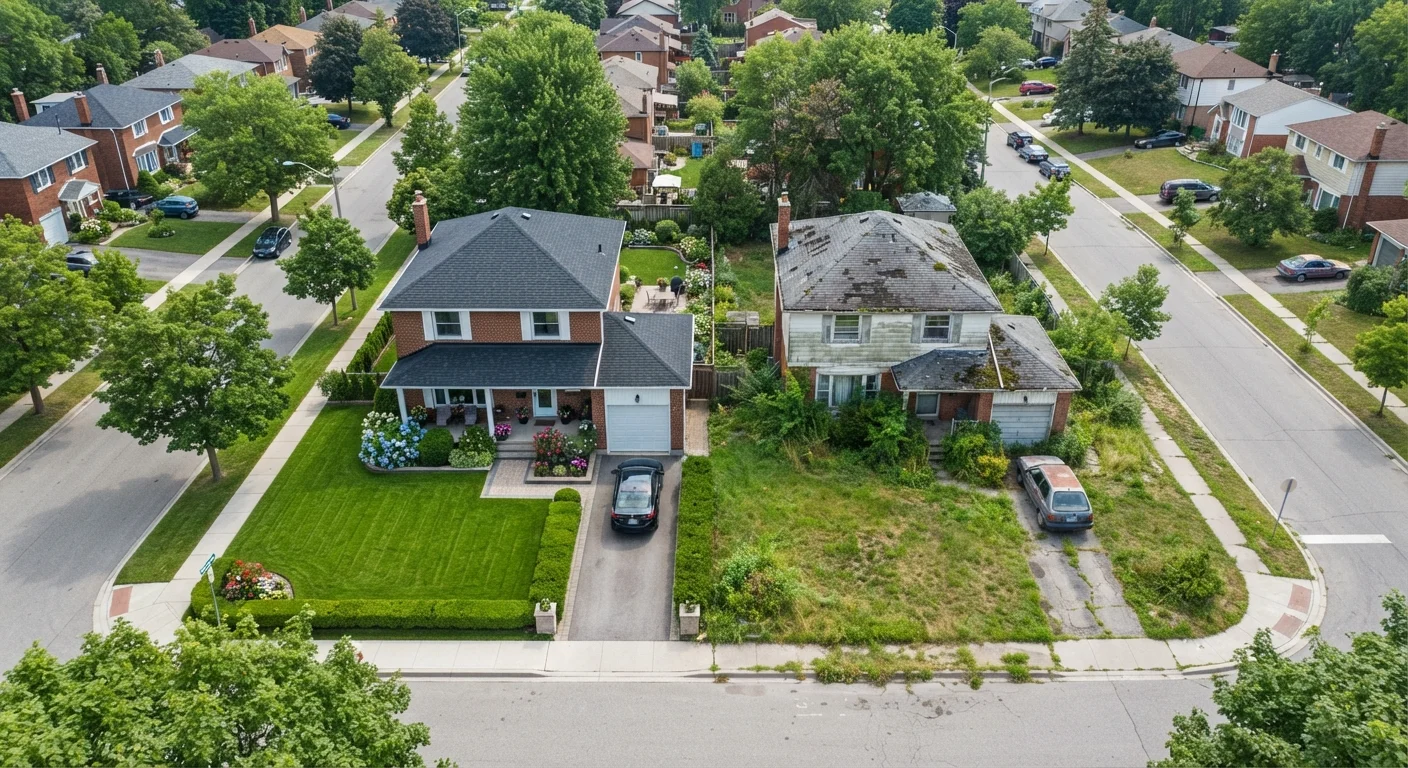
Most people understand that location drives real estate prices - but location explains why homes on one street cost more than homes across town, not why two houses 50 feet apart sell for dramatically different amounts. When neighbors list their homes within months of each other and the prices diverge by tens of thousands of dollars, something more granular is at work.
Property valuation operates at multiple scales simultaneously. Broad market trends affect entire regions. Neighborhood dynamics - school ratings, local investment, walkability - shape block-level prices. But the final number on any individual home is the result of property-specific factors that vary house by house. Understanding those factors is what separates informed buyers and sellers from those left guessing.
For a deeper look at how neighborhood conditions feed into individual values, see how neighborhood-level trends shape individual home values.
~5-15%
Typical price impact of home condition differences
Real estate appraisal guidelines commonly reflect that condition adjustments between properties in otherwise similar locations can shift valuations by several percentage points, depending on the severity of deferred maintenance or upgrades.
Top 3
Value-influencing features beyond location
Industry appraisal practice consistently identifies condition, interior updates (especially kitchens and baths), and lot characteristics as the leading property-specific drivers of price variation among comparable homes.
The Hidden Variables That Move the Needle
Several property-specific factors consistently influence sale prices, often in ways that surprise first-time buyers and sellers alike.
Condition and Deferred Maintenance
A home that has been consistently maintained signals low risk to buyers. Buyers factor in the cost - and the hassle - of repairs when making offers. A neighbor's house with a new roof, updated HVAC, and freshly sealed driveway competes on entirely different ground than a structurally similar home with aging systems and visible wear, even if both were built the same year.
Interior Updates and Finishes
Kitchens and bathrooms carry disproportionate weight in buyer decisions. Updated fixtures, modern cabinetry, and quality flooring can justify meaningful price differences. These updates don't always recoup their full cost, but they strongly influence perceived value. Our coverage of property value myths explores which renovations tend to overperform and which often disappoint sellers.
Lot Position and Physical Characteristics
Lot size, shape, orientation, and position on the street all matter. A south-facing backyard that receives afternoon sun appeals differently than a shaded north-facing lot. A home backing to a busy road or commercial property typically commands a lower price than an otherwise identical house with a quieter rear exposure. Usable square footage of the lot - not just total acreage - influences value as well.
Layout and Functional Floor Plan
A home with an awkward layout - odd room placement, poor traffic flow, or a converted garage that disrupts the floor plan - can struggle against a comparable home with intuitive, functional design. Buyers pay for livability, not just square footage.
Before Listing, Walk the Comparables
Ask your agent to walk you through recently sold homes within a few blocks so you can see firsthand how your home compares on condition, finishes, and layout. This exercise helps set realistic expectations and identifies low-cost improvements that may meaningfully affect your final sale price.
The Role of Presentation and Buyer Psychology
Beyond the physical, how a home is presented shapes what buyers are willing to pay. Real estate decisions blend rational analysis with emotional response. A well-staged home helps buyers visualize themselves living there - a low-friction mental leap that translates into stronger offers and fewer concessions. A cluttered, poorly lit, or impersonally presented home forces buyers to imagine past the noise, and many simply don't.
Pricing strategy also affects perception. A home priced just below a psychological threshold (such as $499,000 rather than $510,000) may attract more competing interest, potentially driving the final sale price higher. Conversely, an overpriced listing that sits on the market accumulates days-on-market, which itself becomes a buyer concern.
Market conditions add another layer. In a seller's market versus a buyer's market, buyer leverage shifts dramatically, and even well-prepared homes price differently than they would in softer conditions.
What This Means for Buyers and Sellers
For sellers, this framework is an opportunity. Closing condition gaps, refreshing finishes within budget, and presenting a home well are all actionable steps that can shift a final sale price in the right direction. Sellers should also work with an agent to understand a comparative market analysis (CMA) that accurately reflects their home's specific attributes - not just street-level averages.
For buyers, the lesson is to look past surface-level comparisons. A lower-priced home on the same street isn't necessarily a bargain - it may be priced lower for well-founded reasons. Investigate the condition, the lot, the systems, and the layout before drawing conclusions. Consider also evaluating the neighborhood dynamics that surround both properties; our guide on evaluating a neighborhood before you commit can help structure that process.
Even in rising markets, individual properties can underperform. Understanding why a home's value can drop even in a strong market is essential context for anyone relying on a property as a long-term financial asset.
This article is for informational and educational purposes only and does not constitute financial, legal, or real estate advice. Consult a licensed real estate professional for guidance specific to your situation.