
Why Mirrors Don't Cover Everything
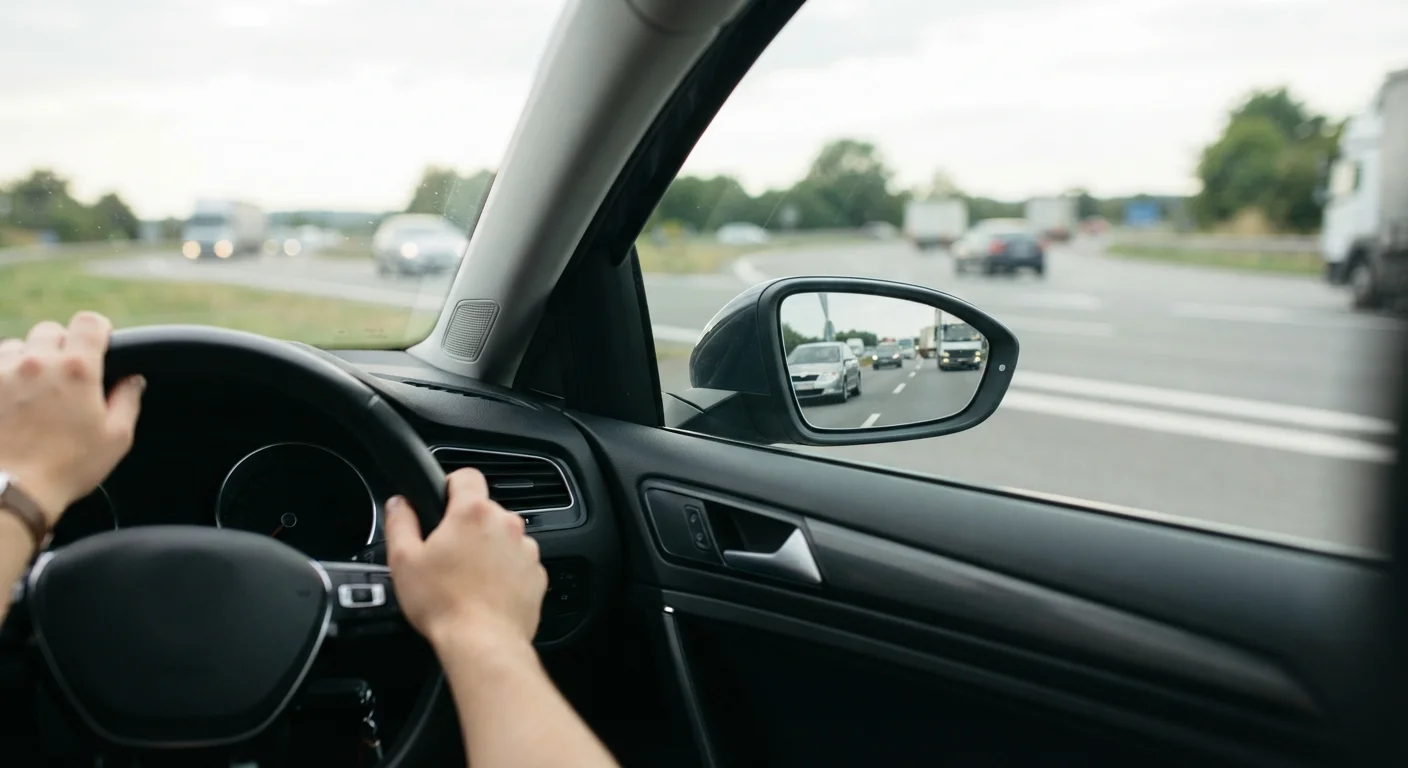
Most drivers assume that three mirrors - rearview, left side, right side - create a complete picture of what's around them. They don't. Mirrors reflect light in straight lines from fixed angles. The moment something sits outside those angles, it disappears from your field of view entirely.
The classic blind spots sit on the rear-left and rear-right quarters of your vehicle. In a typical sedan, a car traveling one lane over can be within arm's reach and completely invisible in all three mirrors. Motorcycles and cyclists are especially easy to miss because of their narrow profile.
There are also secondary blind spots most drivers rarely think about: the A-pillars on either side of your windshield. These structural posts, necessary for roof strength, create visual wedges that can hide a pedestrian stepping off a curb or a cyclist crossing at an intersection. The larger and thicker the pillar, the bigger the obstruction.
Blind Spots Vary by Vehicle Type
There's no universal blind spot size or location - it depends on your vehicle's dimensions, window design, pillar thickness, and mirror size. If you've recently switched from a sedan to an SUV or truck, your existing blind spot assumptions may no longer apply. Take time to relearn your new vehicle's specific coverage gaps.
How to Set Up Your Mirrors Correctly
Mirror position is something most drivers set once - when they first get a car - and never revisit. The default setting many people use points the side mirrors inward, showing a significant portion of the car's own body. That's familiar, but it's not optimal.
A widely recommended technique, originally described by the Society of Automotive Engineers, positions the side mirrors outward until your own car's body nearly disappears from the mirror's edge. This shifts coverage into the rear quarter zones where blind spots typically live. Combined with the center rearview mirror, you get a much wider arc of vision.
It takes a day or two to get used to not seeing your own car in the side mirrors, but the tradeoff is real: vehicles that would otherwise vanish into blind spots appear in the periphery of your side mirror instead. You still need to shoulder-check - but the gaps narrow considerably.
Recalibrate Your Mirrors Before Every Trip
Seat position shifts between drivers - even slight changes in how you sit can move your mirror view angle enough to create a gap. Make mirror adjustment part of your pre-drive routine, not a one-time setup. It takes under 30 seconds and costs nothing.
The Shoulder Check: When and How
A shoulder check is a brief, deliberate glance over your shoulder in the direction you intend to move. It takes about one second and covers the zone your mirrors structurally cannot reach. Done correctly, it's the single most reliable tool for catching what mirrors miss.
The technique: before changing lanes or merging, signal, scan your mirrors, then turn your head about 45 degrees toward the target lane and glance into that zone. You're looking for vehicles, motorcycles, cyclists - anything traveling in the space you're about to occupy. Then steer.
A common mistake is turning too far, which compromises control. A quick scan of the target lane is enough. Merging onto a highway is one of the situations where skipping this step causes the most collisions - speeds are higher and reaction time is shorter.
840,000+
Annual US blind spot-related crashes
The National Highway Traffic Safety Administration has estimated that hundreds of thousands of lane-change crashes each year involve a failure to detect vehicles in adjacent lanes.
~14%
Of all crashes involve lane changes
According to NHTSA crash typology data, improper lane changes and merges - many linked to blind spot failures - are among the most common crash categories on US roads.
3-5 sec
Time eyes leave road during distracted shoulder check
An overly wide or slow shoulder check can take the driver's eyes off the road ahead for several seconds - reinforcing why a brief, practiced glance is safer than a prolonged look.
Technology That Helps - and Its Limits
Blind spot monitoring (BSM) systems, now common on many newer vehicles, use radar sensors mounted in the rear bumper to detect vehicles in adjacent lanes. Most alert the driver with a light in or near the side mirror, sometimes adding an audible warning if you signal toward an occupied lane.
These systems are genuinely useful - they provide continuous monitoring without requiring the driver to keep checking. But they have documented limitations. They can fail to detect narrow objects like motorcycles or bicycles. They may not flag fast-approaching vehicles in time. Sensor range and detection angle vary by manufacturer and vehicle.
Blind spot monitoring should be treated as an additional layer of awareness, not a replacement for proper mirror setup and shoulder checks. Experienced drivers who rely too heavily on technology are among those most likely to develop blind spots in their habits, not just their mirrors. Check your vehicle's owner's manual - it often contains specific guidance on how your BSM system behaves and its known limitations.
Who's Most at Risk in Your Blind Spots
Not everyone on the road occupies the same visible footprint. Motorcycles, cyclists, and scooters are consistently hardest to spot in blind zones - their narrow width means they fit entirely within the gap your mirrors miss. Pedestrians near intersections can be obscured by A-pillars even when you're looking straight at them.
Larger vehicles introduce the reverse problem: when you're driving near a truck, bus, or SUV, you are likely in their blind spot. Commercial trucks have four major blind zones - directly in front, directly behind, and extending diagonally on both sides - and drivers are trained to expect that cars in those zones are invisible to them.
New drivers building awareness of these dynamics early will make safer lane-change decisions for life. Understanding how visibility works around different vehicle types is a foundational road safety concept that pays dividends at every experience level.
This article is for informational and educational purposes only. Always follow local traffic laws and consult official driver safety resources for guidance specific to your jurisdiction.