
Why Most Drivers Ignore the Most Useful Document in Their Car
The owner's manual sits in almost every glove box in America, largely unread. Most drivers treat it as a last resort - something to dig out only when a warning light appears or something stops working. That's a missed opportunity.
Your owner's manual is the only maintenance document written specifically for your vehicle's exact configuration: its engine size, transmission type, emissions equipment, and the fluids engineered to work with all of it. General advice from the internet, or even a well-meaning mechanic, may not match what your car actually needs. The manual does.
If you're new to car ownership, pairing the manual with a broader overview of maintenance priorities is worthwhile - see our guide for new drivers for context on what actually needs attention and when. But the manual itself is where the specifics live.
What you will need
How to Navigate Your Owner's Manual Effectively
Owner's manuals are organized consistently enough that once you know what to look for, finding answers is fast. Here's how to work through it purposefully.
Locate the table of contents and index
Start at the front of the manual with the table of contents, then use the index at the back for specific topics. Most manuals index items under both common names (e.g., "oil") and technical names (e.g., "engine lubrication"). Use both to make sure you're finding everything relevant.
Find the scheduled maintenance section
This is typically labeled "Scheduled Maintenance," "Maintenance Schedule," or "Service Intervals." It lists every service item - oil, filters, spark plugs, belts, coolant, brakes - alongside the mileage or time interval at which each should be performed. Note that most manuals list both a normal and a severe schedule.
Identify your fluid specifications
Locate the section covering engine oil, transmission fluid, coolant (antifreeze), brake fluid, and power steering fluid. For each, the manual specifies the correct type and, for engine oil, the viscosity grade (e.g., 5W-30). Using the wrong fluid type can cause component damage - this is not an area to estimate or substitute without checking.
Check tire and load specifications
Find the section covering tires. It will list the recommended tire size, the correct cold inflation pressure for front and rear tires, and often the maximum load capacity of the vehicle. Cross-reference this with the sticker on your driver's door jamb, which should match.
Review the fuel requirements
Confirm whether your engine requires regular unleaded, mid-grade, or premium fuel. Some engines list premium as "recommended" rather than "required" - the manual will clarify this distinction. Consistently using a lower octane fuel than required in a turbocharged or high-compression engine can cause knock (pre-detonation), which damages the engine over time.
Once you've located the key sections, the manual stops feeling like a dense document and starts working like a reference tool. Flag the pages covering your maintenance schedule, fluid specs, and tire information - those are the ones you'll return to most often.
For questions about oil type specifically, the manual's guidance should always override generic recommendations. Our article on synthetic vs. conventional motor oil walks through how to interpret what the manual actually says about engine oil.
Common Sections Drivers Overlook - and Why They Matter
Beyond the maintenance schedule, several sections of the owner's manual routinely go unread despite containing information that directly affects safety and vehicle longevity.
Warning Lights and Indicators
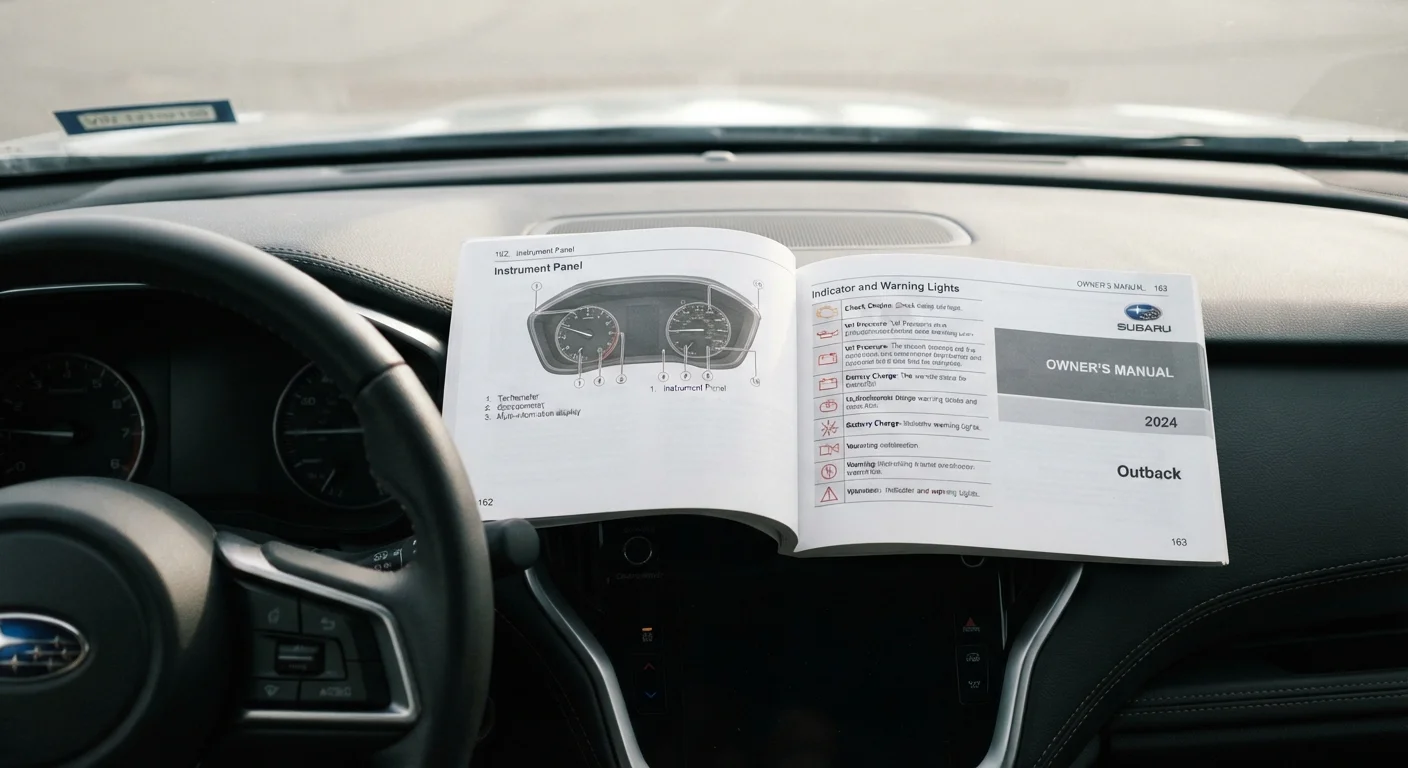
Most manuals include a dedicated section explaining every dashboard warning light, what it indicates, and whether it requires immediate action. This is far more useful than guessing - and more reliable than a generic online search that can't account for your specific vehicle. For a deeper look at one of the most common ones, see what your check engine light is actually telling you.
Severe vs. Normal Driving Conditions
Many drivers assume the standard maintenance schedule applies to them - but if you regularly drive in stop-and-go traffic, extreme temperatures, dusty environments, or make frequent short trips under five miles, you likely fall under the severe-duty schedule. This typically means more frequent oil changes, filter replacements, and brake inspections. The manual defines both schedules explicitly.
Tire Information
The manual specifies the correct tire size, load rating, and recommended cold inflation pressure for your vehicle. This information is also printed on the door jamb sticker, but the manual explains how to read it and what happens if you deviate from it.
Lost Your Manual? Get the Digital Version
Most manufacturers provide free PDF downloads of owner's manuals on their official websites. Search for your vehicle's year, make, and model along with "owner's manual PDF." You can also search by VIN on many manufacturer sites to ensure you get the exact version for your vehicle's configuration.
Ignoring manufacturer guidance on service intervals is one of the more common ways drivers unknowingly accelerate wear - covered in detail in our look at maintenance habits that shorten a car's lifespan.
Using the Manual as an Ongoing Reference
The manual isn't a one-time read - it's a reference you return to as your car ages and your maintenance needs evolve. If your vehicle has crossed the 100,000-mile mark, pairing the manual's guidance with a maintenance overview for high-mileage vehicles helps you identify what deserves closer attention at that stage.
Every time you have service performed, the manual gives you the baseline to verify that what was done matches what your vehicle actually needed - the right oil viscosity, the correct coolant type, the appropriate brake fluid specification. That's a useful check, not a sign of distrust toward mechanics.
It also supports good record-keeping. Logging service dates against the manual's schedule makes it easy to see what's current and what's coming due. For a practical system to track all of this, see keeping records of vehicle maintenance.
Don't Rely Solely on the Mileage Counter
Some vehicles have an oil life monitoring system that calculates when an oil change is due based on driving conditions - not just mileage. If your car has this feature, the manual explains how it works and how to reset it after service. Relying on a fixed mileage interval when your car uses a dynamic monitor - or vice versa - can result in either unnecessary service or oil that's overdue for a change.