
What Defensive Driving Actually Involves
Most drivers think they already drive defensively. What they usually mean is that they don't speed excessively and they stop at red lights. That's a starting point - not the full picture.
Defensive driving is an active process of reading traffic, managing the space around your vehicle, and making decisions ahead of time rather than in the moment of crisis. It requires consistent attention, not just good intentions.
The core elements break down into three categories:
- Hazard awareness: Spotting risks early - a pedestrian about to step off a curb, a truck drifting in its lane, a car slowing without brake lights - before they require emergency response.
- Space management: Keeping enough distance in front, beside, and behind your vehicle so you have room to maneuver if something goes wrong.
- Decision-making under uncertainty: Choosing the safer option even when the road situation is ambiguous, rather than assuming other drivers will behave predictably.
For new or newer drivers building these habits, it's worth reading this grounded overview of foundational road safety concepts alongside this article.
Practice Hazard Scanning Daily
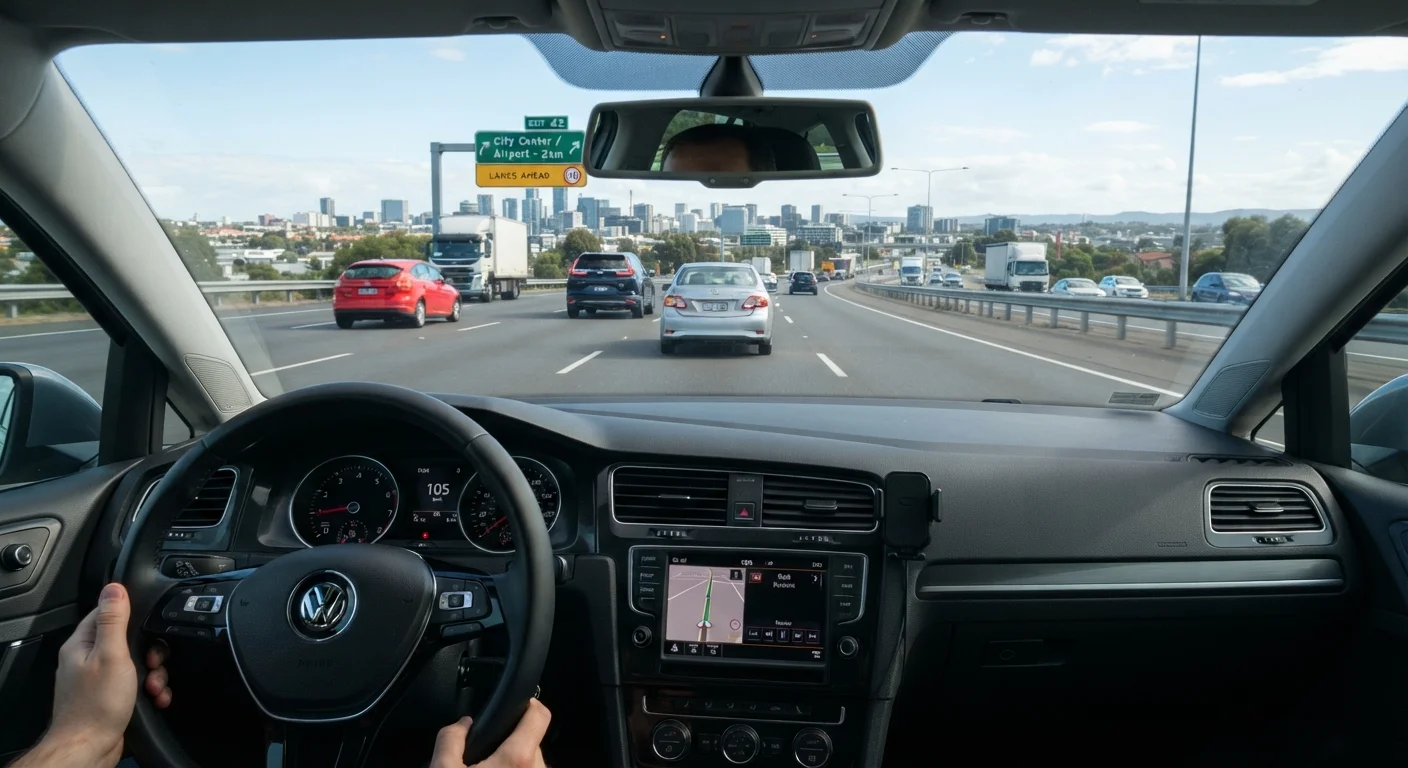
On your next drive, consciously look 10-15 seconds ahead instead of fixating on the car directly in front of you. Note intersections, driveways, merging lanes, and pedestrian areas before you reach them. This habit takes practice to feel natural, but it's the foundation of genuine hazard awareness.
The Principles That Make the Difference
Scan well ahead, not just the bumper in front of you. Looking 10-15 seconds down the road - roughly a city block at urban speeds - gives you time to process what's developing and adjust gradually rather than abruptly. Drivers who focus only on the car immediately ahead consistently have less reaction time.
Maintain following distance as a non-negotiable habit. The two-second rule (three to four seconds in rain, fog, or at highway speed) isn't just a driving school concept - it's the single space buffer that converts a potential rear-end collision into a controlled stop. Closing that gap in heavy traffic doesn't save meaningful time; it eliminates your safety margin.
Be aware of your blind spots and others'. Every vehicle has zones mirrors don't fully cover. Understanding where blind spots exist and when to shoulder-check is a practical extension of defensive positioning - especially during lane changes and merges.
Assume errors will happen. Not cynically, but realistically. Other drivers will cut lanes without signaling, brake unexpectedly, or roll through stops. Defensive drivers don't count on others being correct; they position themselves to have options when someone isn't.
94%
Crashes involving human error or decision failure
According to NHTSA research, approximately 94% of serious crashes involve driver error as a critical contributing factor.
3-4 sec
Recommended following distance in adverse conditions
Safety educators recommend extending following distance to at least 3-4 seconds in rain, fog, or low-visibility conditions compared to the standard 2-second baseline.
5 sec
Average phone glance while driving
The CDC notes that a five-second glance at a phone at 55 mph is equivalent to driving the length of a football field without looking at the road.
Conditions Change the Equation
Defensive driving isn't a fixed behavior - it scales with conditions. Dry pavement at noon and wet pavement at dusk are fundamentally different driving environments, even on the same road.
Rain reduces tire traction and extends stopping distances significantly. Fog collapses visibility. Sun glare at low angles can blind a driver for several seconds. Each condition calls for more following distance, reduced speed, and heightened scanning.
Night driving compounds multiple factors at once: reduced depth perception, dimmer peripheral visibility, and more fatigued or impaired drivers on the road. Night driving hazards deserve their own attention - habits that work fine in daylight don't fully transfer after dark.
Teen Drivers Face Elevated Risk
Inexperience amplifies all the hazards that defensive driving is designed to address. Graduated Driver Licensing (GDL) programs in the US are structured specifically to build defensive habits incrementally. Understanding how GDL works helps parents and new drivers alike see the logic behind staged restrictions.
Distraction Is the Opposite of Defensive
No defensive driving principle survives an inattentive driver. A phone glance that lasts five seconds at 55 mph means traveling the length of a football field without eyes on the road. Distraction doesn't just delay reaction - it eliminates the hazard awareness that defensive driving depends on entirely.
Cognitive distraction (thinking through a problem, talking hands-free) is nearly as degrading to driving performance as visual or manual distraction. Defensive driving requires mental presence, not just hands on the wheel.
A well-maintained vehicle also matters here. A car with worn brakes or underinflated tires limits what a defensive driver can do when a situation develops. Understanding basic vehicle maintenance helps ensure the car itself isn't the weak point in your safety equation.
This article provides general driver education information. Always follow applicable traffic laws and regulations in your state or jurisdiction.